
Investors have seen volatility jump up in the last week, driven by growing caution towards the AI sector, chipmakers in particular (below). The Magnificent 7 stocks (Alphabet (Google), Amazon, Apple, Meta (Facebook), Microsoft, Nvidia & Tesla) are now being joined by Broadcom (>$2T Market Cap), Micron (>$1.0T) and AMD (~$0.9T). Adding to this will be the soon to be listed SpaceX (est. ~$2T), Anthropic (>$1T est.) and OpenAI (>$1T est.). Once these companies are listed and incorporated into the indices, US market will become a proxy for the AI trade as the market weighting of companies with significant exposure to the theme will rise to close to 50% of the overall weighting. This weighting is even higher when one looks beyond the megacap companies and includes many of the chipmakers and infrastructure providers that are essential to modern data centre operation (i.e. interconnect suppliers, construction, cooling, energy, etc.). The Magnificent 7 is likely to become the Fabulous 13 (or some other catchy phrase).
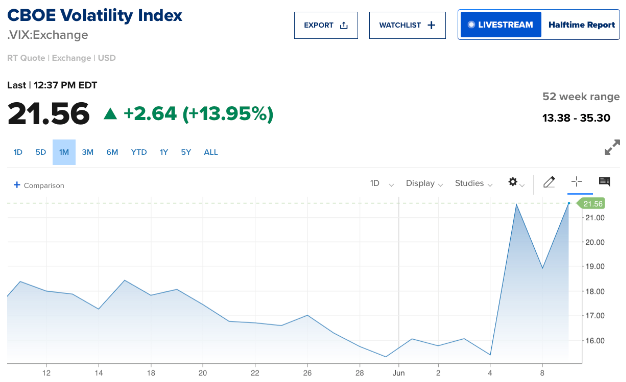
It should not be surprising then that volatility is likely to be high. The AI trade in the last couple of years has not just driven index returns but also has accounted for almost all of the economic growth in the US as a result of the rapid buildout of data centres. Below, we look at some of the factors driving volatility and why it is likely to continue in the near term.
Looking at the assumptions underlying AI operations one sees that data centre profitability is particularly sensitive to variables such as the lifecycle of the chips used and the cost per megawatt to build out a data centre (data centre sizes are generally measured by power consumption rather than physical size). Using some baseline AI capex assumptions (below), Goldman Sachs recently assessed the sensitivity of AI to several key factors.
The Capital Problem
Recently, Google raised $80B in an equity raise that was preceded by over $200B in debt issuances. SpaceX is expected to raise $75B+ later this week in their much anticipated IPO. Analysts expect that most of the other hyperscaler companies such as Microsoft, Meta and Amazon will look to raise equity funding soon to support their infrastructure buildouts. Both Anthropic and OpenAI have filed confidentially for an IPO sometime in the coming months (likely the fall). At this point, we do not know how much they intend to raise but, given their insatiable appetite for capital it is safe to assume that $75B each is probably a low estimate. Anthropic has raised over $125B across 8 funding rounds, including a recent $65B Series H round. OpenAI has raised over $180B including a recent $122B round. Most likely, the private markets are tapped out as far as continued investment goes. They will be looking to exit rather than further fund their AI investments. This means that the public will be expected to fund $100’s of billions in equity investments. Further, debt markets will be tapped for multiple trillions of dollars to fund AI infrastructure projects. To our knowledge, markets have never been expected to fund this much concentrated investment within a short period of time. One of the biggest differences between the AI boom and the dotcom boom (aside from the fact that the biggest companies are profitable now) is the extent of capital intensity required by AI. Recall that dotcom companies were very asset light.
The Business Model Problem
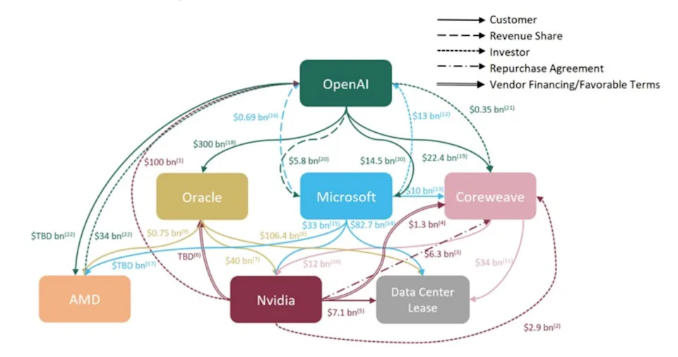
It is expected that once the IPO filings for Anthropic and OpenAI are made public, investors will finally get a clear picture of how these companies intend to make money and how their finances are inter-related with their competitors/partners (below). Many institutional investors have been concerned by the level of related dealings within the AI ecosystem. Many companies wear multiple hats as investors, customers, suppliers and lenders. One of the major risks with these arrangements is that if one of these companies (i.e. OpenAI ) were to have difficulties it could bring down all of the others. Similar, although less concentrated, relationships existed in the dotcom bubble and many of the major players were devastated by the correction. Companies such as Cisco and Juniper Networks barely survived. While companies such as Nortel, Worldcom and 3Com went bankrupt or world sold off for pennies.
The Pricing Problem
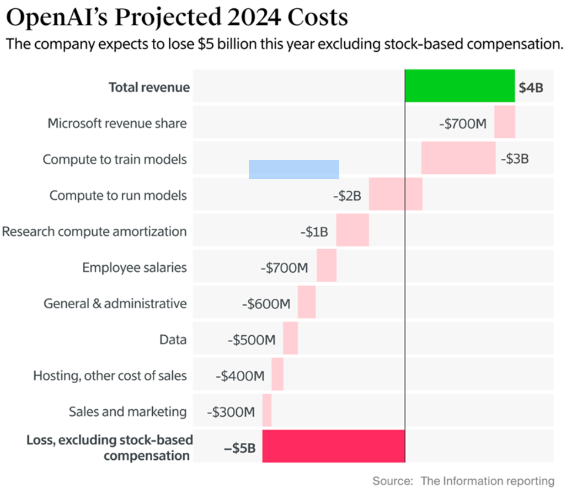
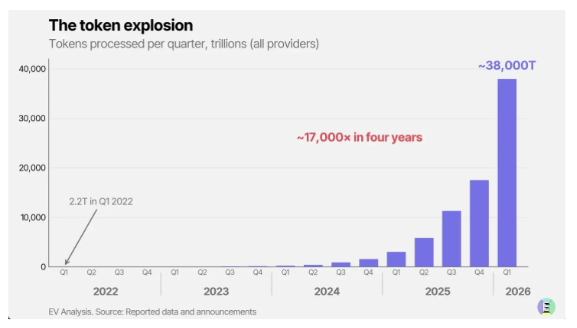
In the coming months factors such as tokenmaxxing and agentic AI are likely to become closely watched. For reference, “In artificial intelligence, a token is the fundamental, atomic unit of data that an AI model reads and generates. Instead of processing whole words, AI models break down text, code, or other data into these smaller chunks. A token can be an entire word, a part of a word, a single character, punctuation, or even an emoji” (Source: Nvidia). Tokenmaxxing is the practice whereby companies have been instructing workers to use as many tokens as possible in order to justify their massive investments in AI. However, AI companies such as Microsoft and Anthropic have begun to change their business models recently and this is making the practice of tokenmaxxing very dangerous. These companies are transitioning their revenue models away from fixed price billing to billing per token. The reasoning behind this transition is that despite a massive drop in the cost per token (>99%), the costs to run and operate modern models has increased to the point where they are losing huge amounts of money per query (below, first). It has been estimated that AI providers spend $3.30-5.00 in compute costs for every $1.00 in revenues. This has led to astounding losses (see below, left for an example from OpenAI). Tokenmaxxing along with the rise of agentic AI (the use of AI agents to conduct operations) has led to a massive increase in the number of tokens consumed (below, second). In response, companies are beginning to charge users based on how many tokens they consume. An AI consultant recently revealed that an unnamed mystery company “accidentally” spent $500M on Anthropic’ Claude model in a single month due to the pricing changes. Uber also reported that they exceeded their full year AI budget in less than 4 months as a result of changing price models.
The Commoditization Problem
Many investors are becoming increasingly concerned that AI is really a commodity that cannot hold long term pricing power. As such, margins would never achieve the levels required to justify premium pricing in the market. Key evidence includes collapsing API costs, rapid performance convergence from open-source alternatives, shrinking times for rivals to match frontier models, and the shift of developer focus from the model to the application and proprietary data layers. If this argument takes hold in the broader market, then it is likely that we will see a significant shakeout.
Investor Takeaway:
From our perspective, as these factors become more closely scrutinized, it is likely that market volatility will increase. There is no doubt that AI is bound to have a profound impact on society. Like many nascent technologies, however, it will take time to determine what works long term. As the market transitions from having only a few ways to play the AI trade to many more, it is likely that winners and losers within the space will begin to emerge. Those companies that can build moats will be successful whereas those forced to compete in a mass commodity space will see valuations and access to capital crumble. This market shift is likely to lead to significant amounts of volatility. The fact that the US stock market and economy have become so reliant on a single theme means that risks have gone up and it is only a matter of time before they get reflected in valuations. It is too early right now to predict the winners and losers, but investors should be watching for signs. It seems likely that more domain/industry specific, cheaper models may become more prominent if costs of the LLMs continue to rise. Many end user companies simply do not have the budgets nor the evidence to justify the increased spending that token based pricing may bring about. This, in turn, may lead to a slowdown in growth.