
SpaceX filed its much anticipated Prospectus last week, giving investors the opportunity to get a better glimpse at its business. Rumours suggest that the Company will be seeking a valuation of $1.75-2.0T on the IPO whilst raising over $80B which would make it the largest IPO in history. It also will be the first of the 3 expected companies to file for an IPO with a valuation over $1T (OpenAI and Anthropic being the others). Even at the bottom of the proposed IPO range, SpaceX would become the 9th largest company by market capitalization in the US, surpassing Berkshire Hathaway. Also, in a first, the Company will be included in the NASDAQ 100 shortly after its debut rather than waiting the traditional 3-12 month minimum depending on the index. Given the excitement surrounding the IPO and its positioning within hot markets such as AI and Space, many investors may be looking to add the company to their portfolios. Below, we look at some of the pros and cons of an investment in SpaceX based on their Prospectus.
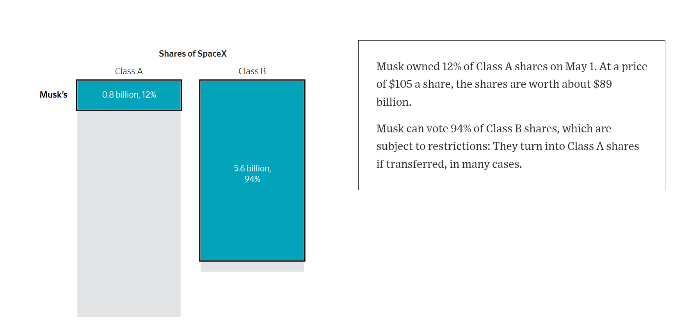
First and foremost, any investment in SpaceX requires a firm belief in its CEO, Elon Musk. Unlike Tesla, Musk will control SpaceX voting (85%) through his 94% ownership of the Class B multi-voting shares (below). This addresses some of his personal frustrations at Tesla where he does not control voting, owing to a single share Class. Thus, any new investor must be comfortable with the idea that Musk will call the shots, and every other investor is along for the ride. Early Tesla investors have profited greatly since their IPO so this may not be a bad thing but one must remember that Tesla went public at a much more modest valuation. It went public on June 29, 2010, with a valuation of $1.7B (almost 1,000x return). Clearly, such a return is not feasible for SpaceX any time soon as the entire S&P 500 is worth only $67T.
COMPANY OVERVIEW
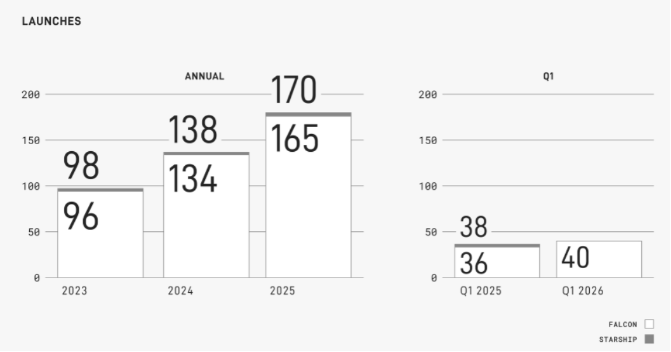
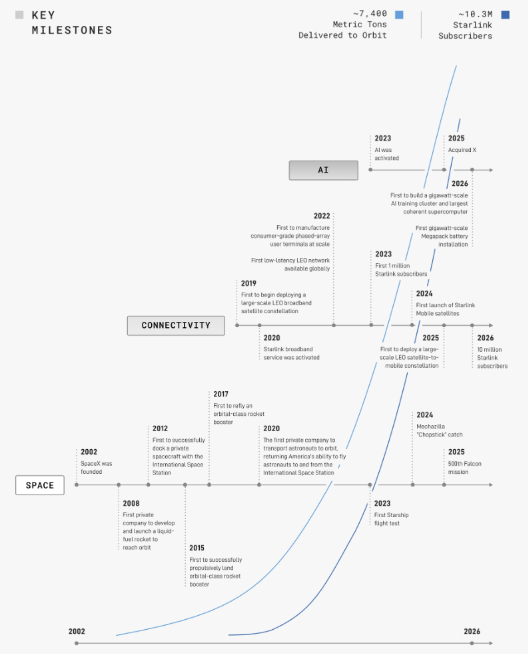
SpaceX is currently divided into 3 business segments: Space, Connectivity and AI. The initial business, launching rockets into space, is older than most realize. It was started in 2002, funded from some of Musk’s profits from the sale of PayPal, of which he was a co-founder. SpaceX pioneered the development of reusable rockets which led to significant cost advantages. Consequently, it holds an 80% market share of total mass launched into space as of 2025. Their near monopoly position in rocket launching is a testament to the quality of their technology and a curse in that the only path to growth is organic expansion of the market (ever more rockets need to be launched).
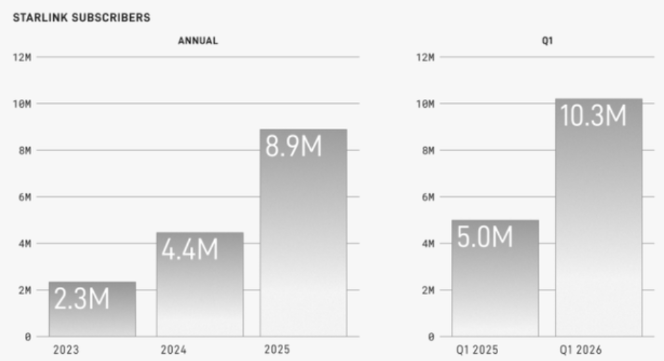
The Connectivity segment has grown to become the revenue/profitability driver thus far. It is the Starlink Satellite Internet service that is available in more than 160 countries and relies on 10,000 Low Earth Orbit (LEO) satellites. At present, they have about 10M subscribers, primarily in developing countries and rural developed markets. The service provides relatively high-speed connectivity, but nothing compared to the speeds available via fiber optics.
The final segment, AI, was founded in 2023 as a merger between X (formerly Twitter, which Musk bought personally) and xAI. The merged entity was then combined with SpaceX earlier this year. It is home to the AI LLM (Large Language Model) known as Grok. It competes directly with ChatGPT (OpenAI) and Claude (Anthropic), although it is much smaller at present. The Grok platform has 117M monthly users compared to over 1B for OpenAI’s ChatGPT. Their X platform has 550M users.
FINANCIALS
Looking at SpaceX’s financials, it is hard to justify a $2T valuation (below). There are many red flags that investors should be aware of. The Company is not growing revenues as fast as one would expect. Revenue growth for Q1 2026 was about 16% YoY while expenses grew 64%. The only profitable business segment is Connectivity (Starlink). In 2025, the Company lost ~$5B which grew to almost that level in Q1 2026 ($4.3B loss from $0.5B YoY). Total revenues for FY2025 were ~$19B, meaning the Company is looking to IPO at 100x trailing revenue with a 16% growth rate. Even if the Company were able to return every single penny of revenues to shareholders rather than spending it on staffing, CapEx, operating expenses, marketing, etc., it would take almost 20 years to return the initial investment at a 16% annual growth rate. Of course, companies can’t return all their revenues, they have to generate returns from their profits which are some distance off for SpaceX.
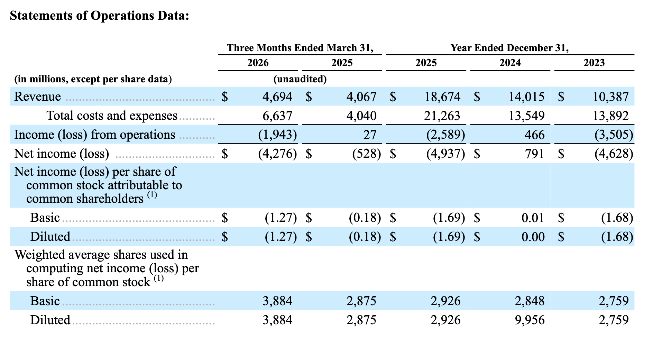
On top of this, there are other issues investors should consider. The Company intends to use almost 80% of the IPO proceeds ($80B) to pay off debt ($63B). SpaceX’s most profitable segment, Starlink is seeing its Average Revenue Per User (ARPU) decline significantly as it chases growth. In 2023, Starlink ARPU was $99/month. By 2025, it had fallen to $81/month. In Q1 2026, it fell even further to $66/month. This is a function of the Company extending its user base outside of North America where price sensitivity is much higher.
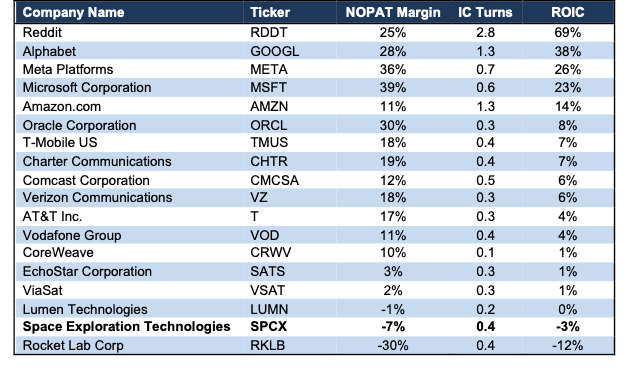
At present, the Company’s profitability puts it near the bottom of its closest competitors (below). Only fellow space-oriented Rocket Labs has worse profitability metrics.
The Company stated in their IPO filing that their “internal controls over financial reporting currently do not meet all of the standards contemplated by Section 404…” Additionally, the company “cannot conclude in accordance with Section 404 that we do not have a material weakness in our internal controls.” Weaknesses in internal controls raise the risks of restatement or other reporting issues in the future. As a private company, SpaceX was not required to maintain a rigorous set of books.
In January 2026, SpaceX granted Elon Musk 1 billion performance-based restricted shares of Class B common stock. The restricted shares only vest upon the company’s achievement of specific market capitalization milestones across 15 equal tranches, which range from $500 billion to $7.5 trillion, and the company’s establishment of a permanent human colony on Mars. In March 2026, SpaceX cancelled Elon Musk’s previous xAI award and replaced it with 302 million performance based restricted Class B shares which vest upon market cap goals split over 12 tranches and the company’s completion of non-Earth-based data centers. Investors should be aware that if the Company is successful in achieving some of its lofty ambitions that an unprecedented level of dilution is likely as Musk stands to profit as much as $1T from these agreements.
THE VISION
At this point, investors may be wondering how the Company can justify its valuation. We would argue that much of the value of the Company falls to believing the Vision that Musk has for SpaceX. It is ambitious to say the least. Probably, the most ambitious Prospectus one is ever likely to read. In its public IPO Prospectus, SpaceX outlines its core mission as an effort to “extend the light of consciousness to the stars”. Among its visions statements are”:
- The Existential Pitch: The company tells investors that confining human civilization to Earth exposes it to unpredictable existential threats. Multi-planetary colonization ensures “species-level redundancy” so that the light of consciousness won’t perish if humanity faces planetary hazards.
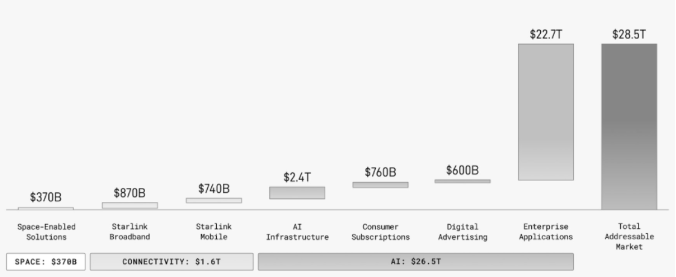
- Cosmic Economics: SpaceX outlines a massive $28.5 trillion total addressable market that encompasses artificial intelligence and space-based data centers, justifying the listing’s reported goal of a $1.75 trillion valuation.
- Kardashev Type II Status: The prospectus asserts that the next paradigm shift for humanity is achieving Kardashev Type II status—the ability to capture the full energy output of the Sun to power future tech and space expansion.
Amongst its business goals are:
- Orbital AI compute: Essentially, Data Centers in space. There are several logistical issues with this. One, the technology to build, launch and operate a fleet of data centers in space does not exist at present. Two, Musk has estimated that millions of satellites would be required. Given the fact that LEO satellites have a lifespan of 5 years, it would require hourly launches of rockets 24/7 365 days year to maintain the fleet.
- Space Colonies: SpaceX mentions that its ultimate goal is to establish colonies on the Moon and Mars. “By moving beyond the only home we have ever known, we ensure species-level redundancy and the light of consciousness will not be tied to a single planet subject to the inevitable hazards of a harsh and vast universe. We do not want humans to have the same fate as the dinosaurs.”
Overall, SpaceX outlines a vision whereby its total addressable market is $28.5T. This is greater than the GDP of the US. Several items pop out from this estimation. The biggest being the $22.7T Enterprise Application market. Gartner estimates that the global enterprise application market is ~$450B. It is not clear where the money would come from vis-à-vis customers to pay for this vision even if their products were compelling. Similarly, assuming that Starlink could reasonably address the $870B broadband market would require assuming that they can somehow displace all other forms of broadband.
Investor Takeaway:
One of Elon Musk’s greatest strengths has been to sell the market on his visions. He promised full self-driving cars would be a reality by 2015. Tesla even charged for the service. To date, no Tesla’s are available to consumers that are fully self-driving. Likewise, he stated in 2011 that humans would reach Mars in 10 to 15 years. He has never been shy to offer grandiose visions. For the most part, investors have been comfortable giving him the benefit of the doubt and have profited handsomely from it. The interesting question at hand is whether the law of large numbers will catch up to him. SpaceX’s purported $2T valuation means that most of the “easy” money has been made in the Private Equity markets. He is now relying on investors to be patient with generally low growth businesses while he prepares them for an ambitious future. Potential investors need to weigh the risk and reward of an allocation to the Company. In the short run, it is easy to imagine that there will be plenty of opportunities to trade the stock for profit, both long and short. Over the long run however, investors need to ask themselves whether there is enough there to sustain high valuations relative to the competition. At its IPO, it will be the only member of the $1T+ club that doesn’t make any actual profits. It will also have one of the lowest growth rates. Famously, Elon Musk once claimed that SpaceX would only go public after they reached Mars. It seems their need for capital has sped up the timeline. This insatiable need for capital will likely also lead OpenAI and Anthropic to the public markets this year.