
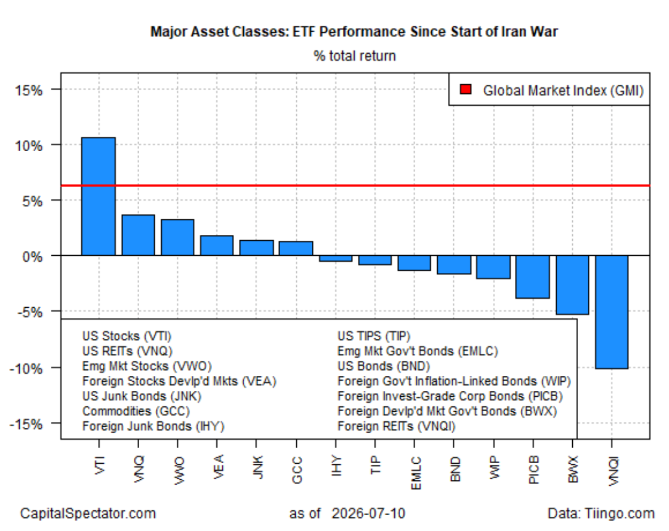
Since the war in Iran began markets have been volatile but surprisingly strong. Many equity and bond ETFs are up YTD despite all the issues with the conflict in Iran, inflation and economic uncertainty (below). For the most part, the market has disregarded the Conflict because of the constant whipsawing of policy. US equities have performed well with the Vanguard Total Stock Market ETF (VTI) up almost 11% since the start of the bombing. The current thinking seems to be that the Iran conflict has created a temporary lift in inflation that will subside once there is a resolution. The problem that is becoming increasingly clear is that this situation may not resolve itself in the near term and that inflation may become a more ingrained issue that Central Banks will have to address through higher rates.
Despite these concerns, the equity markets were humming along nicely, albeit with a higher level of volatility than normal, until concerns about the AI trade began to surface. The SpaceX IPO put a spotlight on this trade as Anthropic and OpenAI both filed for IPOs on the back of SpaceX’s filing. However, with increased attention comes increased scrutiny and it now appears that OpenAI may be losing the market’s confidence along with its competitive positioning which may turn out to be disastrous for the AI trade and markets in general. A number of factors are leading to this caution and below we outline a few of them.
Competition
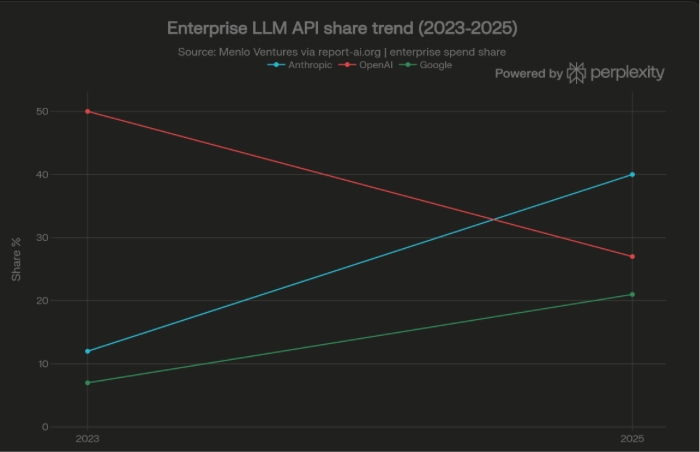
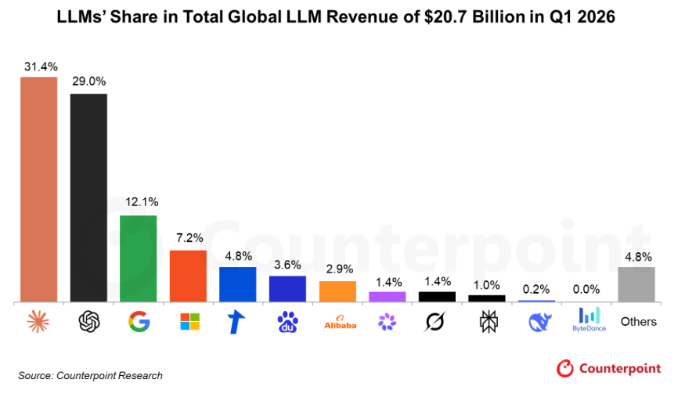
OpenAi was the clear leader in Generative AI and Large Language Models (LLMs). While it is still the leader in consumer adoption, it may soon be relegated to third place behind Anthropic and Google in the all-important enterprise space (below, top). The enterprise market is most important as this is where the bulk of the revenues lie. Consequently, Anthropic has now passed OpenAI in revenue generation (below, bottom). It currently sits at 29% revenue market share and is under threat from those trailing it such as Google and Microsoft.
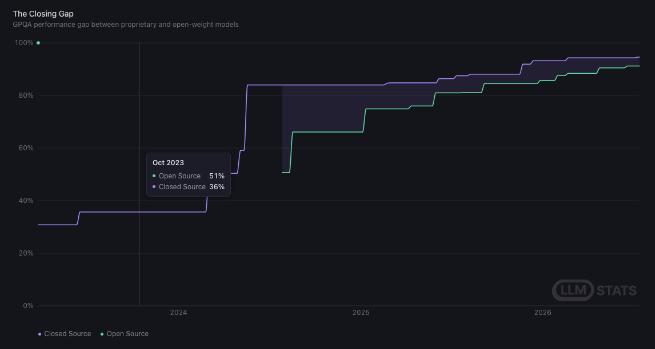
On top of competition from the major players, the gap between Proprietary Models such as OpenAI’s ChatGPT and Anthropic’s Claude and Open Source Models is beginning to close dramatically led by Chinese companies such as DeepSeek (below). Given the price difference per 1M tokens ranges for the latest LLMs from OpenAI (GPT-5.4 Pro) and Anthropic (Claude Mythos 5) are $10-180 (depending on input or output) and those for Open Source Models such as DeepSeek range from $0.10 to $3.00 per 1M tokens. There is going to be huge pricing pressure on these providers going forward.
The Apple Lawsuit
Apple filed a lawsuit on July 10th alleging that OpenAI stole trade secrets from Apple. In all, they hired over 400 engineers from Apple as they have been looking to develop hardware devices that can be used to host and access AI models. The issues began when OpenAI bought IO, a company founded by former Apple design chief Jony Ive for $6B. Apple is seeking to block OpenAI from using stolen information, redesign any products based on this information and unspecified damages. If the legal filings from Apple are true, then OpenAI is going to have a very difficult time defending itself. The filings point to clear examples of former Apple, now OpenAI employees hacking into Apple data and downloading key information. They even appear to gloat and laugh about how easy it was for them to access the info. It appears that potential hires were encouraged to bring protype hardware to job interviews. If these allegations prove to be true, they could be devastating for OpenAI’s reputation and prospects for a near term IPO.
The Microsoft Problem
Microsoft was an early investor in OpenAI, eventually putting in about $13B into the Company. In return, Microsoft received equity, exclusive cloud provider status, access to IP and a revenue share agreement. For the most part, all of these, except the equity, have either been eliminated or severely diminished. Both companies have sought greater flexibility. OpenAI has looked for more partnerships and Microsoft has felt that OpenAI’s tech is lagging. They are now directly competing against each other in many areas.
The Data Centre Issue
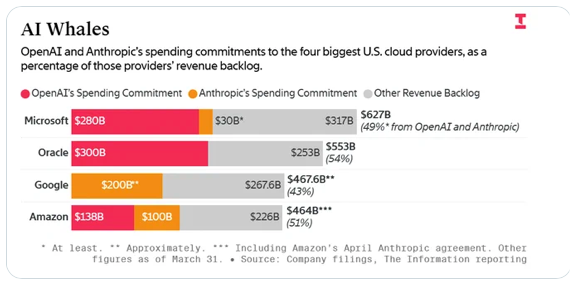
OpenAI and Anthropic are essential components to the whole data centre narrative. Just looking at the 4 largest hyperscalers (Microsoft, Google, Oracle and Amazon) shows that they are dependent on OpenAI and Anthropic for about half of their expected revenues going forward (below). If either company fails to deliver on these spending commitments the knock on effects could be catastrophic as there are no other major players with the access to funding required to make up the difference. For the hyperscalers, one of the biggest problems is that they are growing increasingly dependent on debt to fund the buildout of their data centres. This analysis doesn’t even cover the impact on Nvidia who would be supplying the bulk of the GPU chips, nor does it look at the other players in the AI infrastructure. Already this year there have been more announced delays of over $130B in data centre builds versus $125B last year. Power and permitting constraints are beginning to move expenditures out.
Investor Takeaway:
If OpenAI is forced to significantly curtail its plans or face a closed IPO market for an extended period, the knock-on effects will be large. Many of the largest companies are materially tied to OpenAI and Anthropic spending. Continued bad press is likely to erode investor confidence in the AI trade. It is wise for investors to consider some of these factors before getting too aggressive on “buying the dip”. The current weakness in AI stocks may portend to a longer downturn in the sector. Already, we have seen the enthusiasm for SpaceX to be waning as it drops towards its IPO price ($135) from an opening price of $200. This may serve as a bellwether for the prospects of an OpenAI or Anthropic IPO.