
A recent analysis by Scott Rubner of Citadel Securities suggests that the market is likely to rise in the short term. Citadel is uniquely positioned to see and comment on market activity given their leading role as a market maker for both equities and options trading. It is estimated that they handle about 35% of all retail trading flows. For a variety of reasons (discussed below) the market is set up to trade higher rather than lower, although as always things may change. The essence of his argument boils down to 3 major themes: record retail participation, a technical reset into quarter end, and a favourable seasonal backdrop. As such he concludes: “Over the next two weeks, price action is likely to be driven more by flows than fundamentals as investors navigate month-end, quarter-end, and first-half rebalancing activity. The market is set to absorb the largest options expiration in history, significant quarter-end pension rebalancing flows, and a broad reset in positioning across major investor cohorts.” Below, we examine these arguments and suggest some areas for investors to watch out for that may trip up this viewpoint.
Retail Investors Are Driving Demand
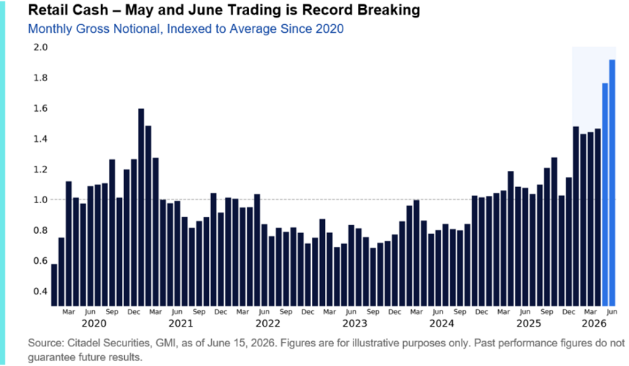
Retail investors are playing the market at record levels (below). According to Citadel, their investment behaviours have changed relative to the past. They are not only actively investing in the market, but they are less sensitive to market movements, preferring to buy the dips rather than sell on them. Retail cash equity volumes are running 60% higher than the 2025 average and more than double 2024. Further, Friday June 12 marked the largest single day of retail net buying in their dataset by over 50% (presumably driven by SpaceX’s IPO.
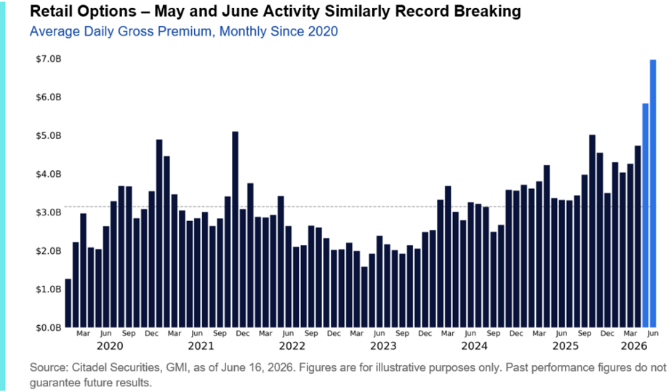
Similarly, retail investment in options continues to climb. “Average daily options volume on the Citadel Securities retail platform reached a record high in May, running 20% above the trailing one-year average. Participation has continued to build in June, with volumes surpassing the highs made last month by another 20%. (Source: Citadel Securities, below)”. This June, retail options trading has reached $7B of options premium per day. Unlike prior periods of high levels of option trading, today’s retail investor is not only chasing speculative companies, but they are also increasing activity on megacaps that are driving benchmark and institutional returns.
While buying the dip has long been a retail strategy, it is reaching new levels. In 2026, buying activity on the SPX (S&P 500 Index ETF) is almost 3X the long term average (below).
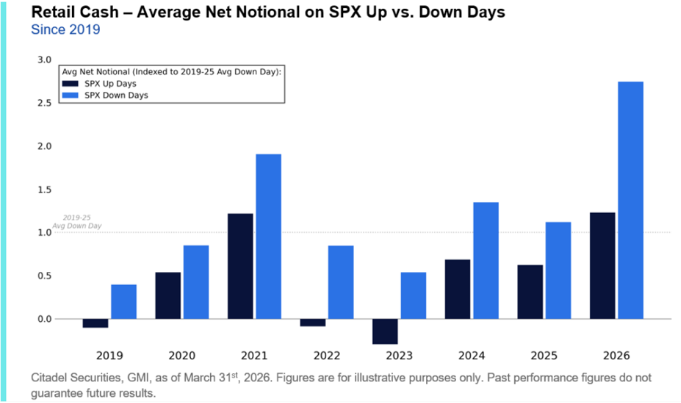
Taken together, these data point to a retail investor who is still quite bullish on the market prospects.
Technical Reset
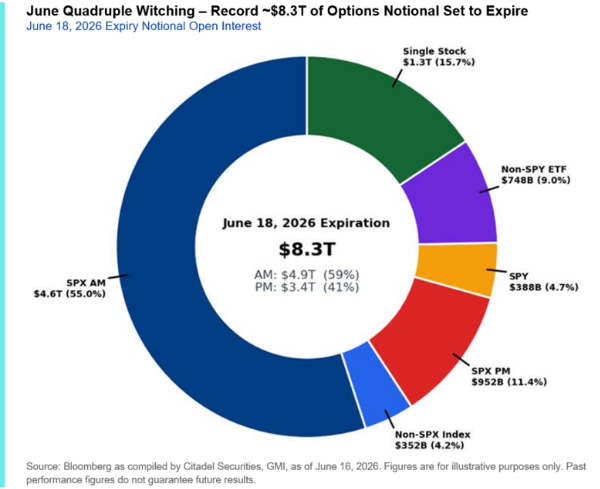
Last Friday (June 18) represented the largest options expiry of all-time. Fully 28% of all listed options expired on June 18 (below). This represented $8.3T of exposure rolling off, that easily eclipsed the previous high of $7.1T in December. This roll off cleared many hedge trades required by counterparties, usually investment banks, to neutralize their options exposures.
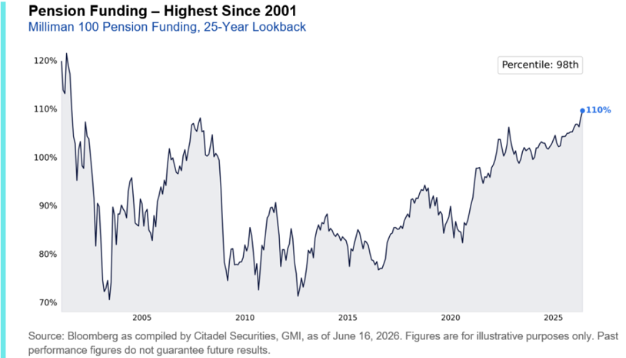
Further, Pension Funds will be starting the process of their quarterly re-balancing. At present, the Top 100 Pensions in the US are currently 110% funded (below). As the 2nd Quarter comes to close, these funds will likely look to re-allocate their portfolios somewhat. They also may adjust exposures and reduce leverage, particularly if they are exceeding their benchmarks.
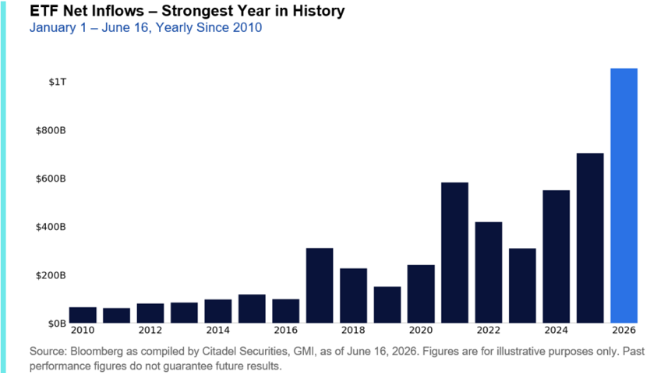
Increasingly, the market is being pushed upwards by ETFs. They now account for 31% of average daily trading volume, above their 10-yr average of 27%. Year-to-date, ETF inflows have tallied to over $1T, 45% ahead of last year’s pace (below). This type of buying carries little information as ETFs are rules-based investors (generally by market cap or sector depending on the style of the fund). What is important to note is that large ETF buying tends to favour large companies over small as most ETFs are indexed by market cap weighting.
Seasonality
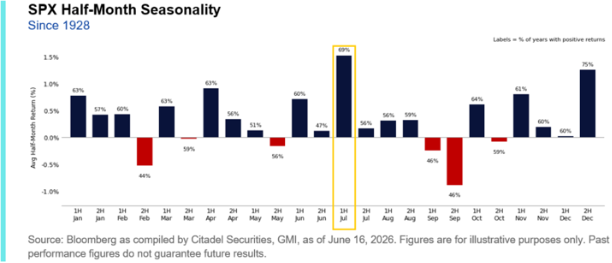
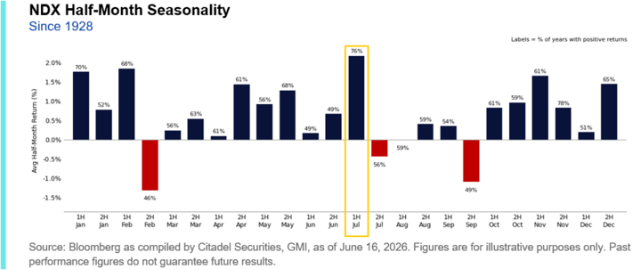
Historically, the first half of July has been among the strongest periods for returns in the year. Among the stats quoted by Citadel are:
- Since 1928, the S&P 500 has advanced 69% of the time during the first half of July, generating an average return of 1.5% and an average rally of 3.2% when positive.
- Since 1985, the Nasdaq 100 has risen 76% of the time, with an average return of 2.2% and an average rally of 4.4%.
In fact, the S&P 500 has finished higher the last 11 Julys whilst the NASDAQ has closed higher 17 of the last 18 years (below).
Risks
While the analysis presented by Citadel makes a compelling case, investors should be aware of several bogeymen lurking in the background that could derail this trade.
One, the analysis was written prior to Kevin Warsh’s first meeting as Fed Chair. The FOMC held rates at 3.75% but eliminated any easing bias that was present. Half of the FOMC members have indicated that they favour at least one rate increase before year end. Clearly, they are becoming far more worried about persistent inflation than the market is. In response, the ten-year bond yield jumped toward 4.5%.
Two, market concentration increases the risks for a sudden correction if the AI trade loses steam. Increasingly, the US market is becoming highly dependent on a single investment theme with little backup. The high dependence on ETF inflows to help maintain buying interest, as opposed to stellar operational performance in some cases, means that risks are elevated.
Three, geopolitical risks have not gone away. The recent ceasefire/peace deal with Iran remains fragile and is likely to have ups and downs. On the face of it, the US appears to have decided to walk away from its initial stated objectives. It remains to be seen if an about face occurs should the American people start to grumble about the deal.
Investor Takeaway:
The market has been doing an excellent job of ignoring negative factors for some time. As Citadel points out, there are many historical/technical factors that point to a market rise in the short run. It is hard to bet against it at this point. We would, however, encourage investors to keep an eye on a number of factors that could change market perceptions quickly. One, increased volatility. If the market starts to see increased volatility as measured by the VIX rising to 30 or more then dip buyers tend to step back, according to Citadel’s own research. Two, if the market breadth continues to narrow then it is likely that many institutional investors will reduce exposures for risk management purposes. Lastly, if the long end of the interest rate curve continues to rise then the bond market will start to soak up excess liquidity over the stock market. As always, we recommend investors remain vigilant.