
This past week has not been short on potentially market moving news flow. In this note we review a few of the potentially most impactful items and discuss what investors should look out for. The most important of which is the potential war/destabilization of the Middle East following the US/Israeli bombing of Iran. In the short run, it is also the least likely to be market moving unless it escalates significantly for the reason we will discuss below. Additionally, a recent speculative piece written by a stock research firm, Citrini Research, roiled technology markets with an analysis of what markets would be like if AI-predictions come true. Finally, concern has been building that Private Credit defaults could lead to instability in the fixed income markets.
MIDDLE EAST CONFLICT
The US and Israel jointly bombed Iran over the weekend. The rationale behind these strikes remains murky. Trump set out a number of reasons, none of which seem to pose an imminent threat:
- Regime change – The current regime has been in power for decades and did not seem to be doing anything recently that suggested immediate action was required.
- Prevention of nuclear proliferation – Nuclear talks were set to resume next week so it is unclear why he struck before the talks concluded.
- Destroy missile production – The fear is that Iran was working on long-range ballistic missiles. Intelligence seems to suggest that they were years away from development.
- Annihilate its Navy – Not clear why this is an issue at present.
- Avenge attacks on US Servicemen – These attacks have occurred over 47 years. And
- Halt the Islamic Republic slaughter of its own people – Not sure why this is an issue for war.
By directly attacking Iran and killing their Supreme Leader, the US and Israel are pushing Iran onto a knife’s edge. It may result in a regime change to a more moderate government or it may empower the military and religious factions to tighten their grip. Regardless, the history of US military involvement in the Middle East (Iraq, Libya, Syria, Afghanistan) suggests that any market drops will be temporary as these regions generally don’t pose a direct threat to the US. Where this conflict could be different is the sheer size of Iran. With a population of over 90M, Iran is the second largest Middle Eastern country after Egypt. Its military is estimated to be about 1M strong – between the regular army, Revolutionary Guard and reservists. By contrast, the US military is approximately 1.3M active-duty personnel and 700-800k reservists. Israel adds another 175k active-duty and 450k reservists. Since neither the US nor Israel share a border with Iran, any land battle would be very difficult and prolonged. If the US and Israeli stick to airstrikes and then claim victory after a few weeks (whether they achieve stated goals or not) then the effects on the markets are likely to be short term and muted. If, however, battles escalate throughout the Middle East and oil and gas production/delivery is significantly impacted then markets are likely to react badly. Any long-term effects on oil & gas production could trigger a global economic slowdown. Until then, investors should take a more wait and see approach.
THE CITRINI REPORT – AI WINTER
Citrini Research recently wrote a thought piece imaging what the world would be like in 2028 if the most bullish AI predictions came true (here). In the piece, the unemployment rate is over 10% and the markets had suffered through a 38% drawdown as wealth accumulates to the owners of compute power. Productivity gains came at the expense of workers. The basic idea is that if AI achieves the most bullish scenarios, then swathes of the knowledge workforce will become irrelevant as these tasks will be replaced by AI Agents. The fear created by this report added to the already edgy software and tech markets (below, left). Much of the market premium (excess P/E) that has accrued to technology stocks over the last 5 years has been eroded (below, right). A recent academic paper led by Nobel laureate Daron Acemoglu, with co-authors Dingwen Kong and Asuman Ozdaglar, asked if AI is making us dumber: “AI, Human Cognition and Knowledge Collapse”. One of their conclusions was that, “When human effort is sufficiently elastic and agentic recommendations exceed an accuracy threshold, the economy can tip into a knowledge-collapse steady state in which general knowledge vanishes ultimately, despite high-quality personalized advice.” The recent scuffle between Anthropic AI and the US Department of Defense over the use of Anthropic’s AI models led to Anthropic being barred from Defense contracts. Anthropic had agreed to provide its AI, Claude, to the DoD on two conditions: First, it cannot be used in the surveillance of U.S. citizens within the U.S. Second, autonomous targeting systems must have a human safeguard before an “attack” decision is made. There is ample evidence that unconstrained AI can lead to bad outcomes. Kenneth Payne at King’s College experimented with AI in war game simulations. In 95% of the situations, the AI resorted to the use of tactical nuclear weapons, which is a threshold that most people would be strongly against.
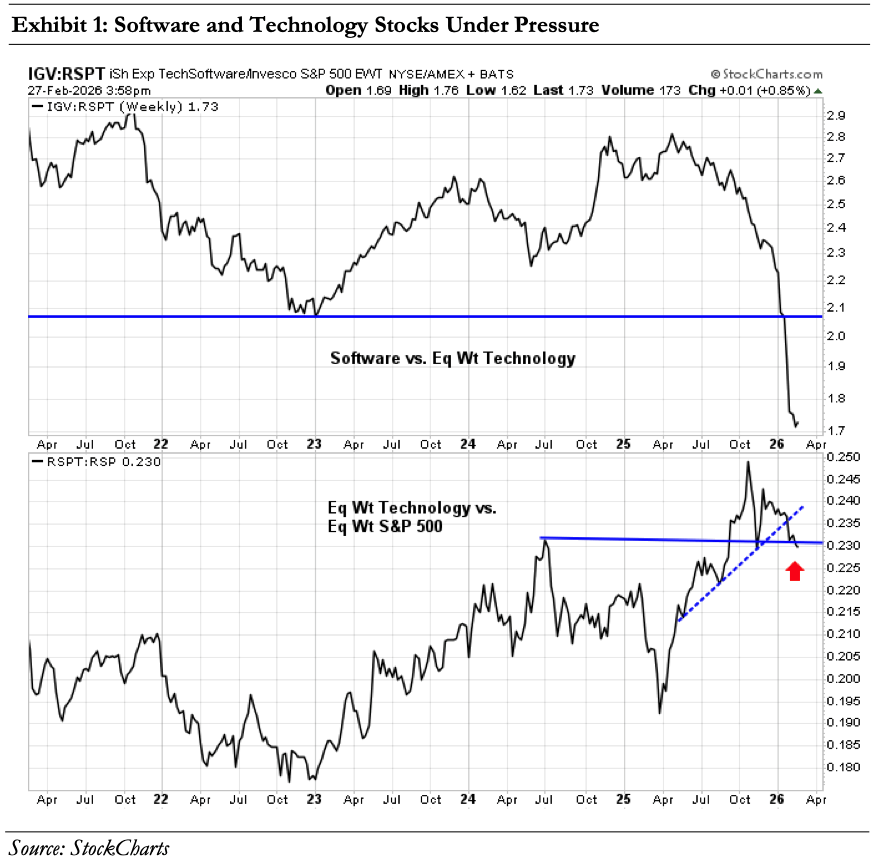
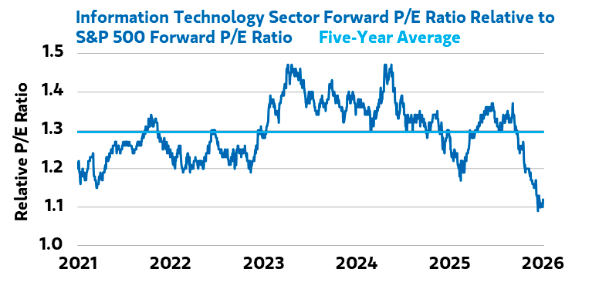
While the Citrini report is a work of speculation, it highlights some of the potential implications of uncontrolled application of AI. Most people would not be in favour of massive productivity gains for corporations if they came at the expense of widespread unemployment. Recently, Jamie Dimon, the CEO of JP Morgan, posed the question at an AI investor conference:
“What if, I think there are 2 million commercial truckers in the United States, and there are lots of other examples you can give. There’s a thought exercise, and you could push a button, eliminate all of them, and they make $120,000 on average. Save fuel, save lives, save time, a more efficient system, less disrupted highways, all that beautiful stuff. Would you do it if you put 2 million people on the street where even if there are jobs available, that next job is $25,000 a year, stocking shelves. I was saying, “That’s kind of really bad, kind of civilly, should we as society agree to that?” I don’t think so. I was talking about the business and government, and they should start thinking today, not when it happens, what would we do to deal with the [AI] issue? It’s got to be business and government.”
These are important questions that need to be considered as they can have lasting implications on industry and the economy. There is no doubt that AI can prove valuable but it can also lead to disastrous consequences if allowed to proliferate unchecked.
PRIVATE CREDIT
The Private Lending market has gone from a niche market to the mainstream over the last few years. It was recently opened up to individual investors seeking higher yields. It is now a $2T market. The attraction of the market has been high yields with lower volatility (below) as measured by the Sharpe Ratio. Detractors would point out that this is a fiction. The volatility is low because Private Credit firms are not required to mark-to-market the way public lenders are. Consequently, they tend to hold loans at book value until there is an impairment.
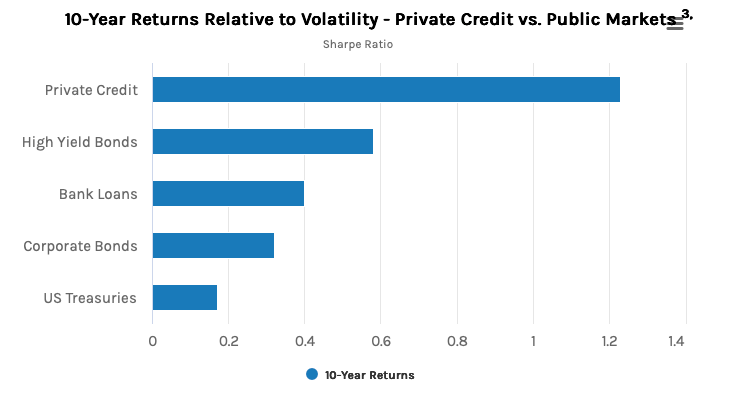
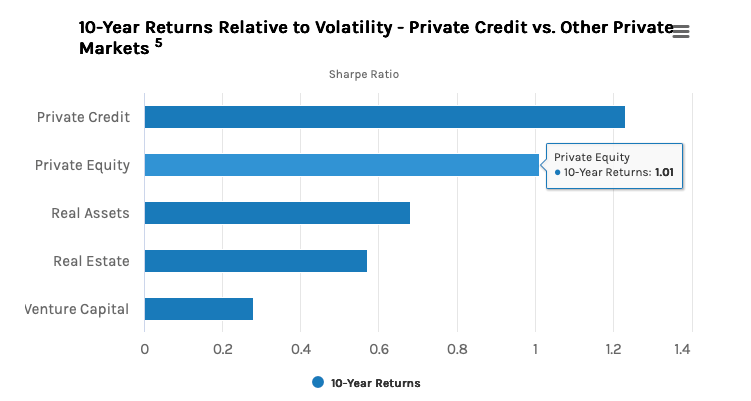
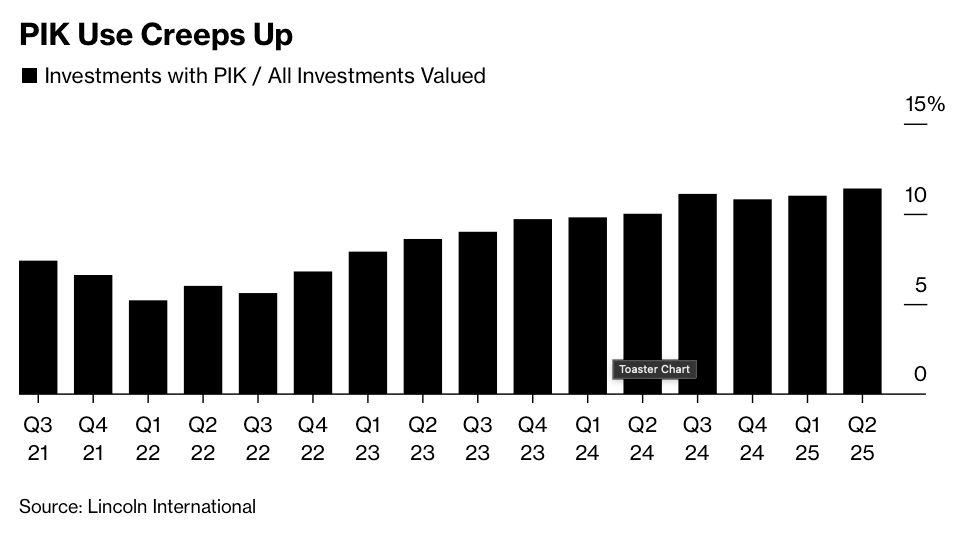
Jamie Dimon also recently said that some of his rivals are doing “dumb things” in their lending practices. It is presumed that he was referring to aggressive Private Lending practices. UBS added fuel to the fire when their analysis indicated that Private Lenders could face up to a 15% default rate, well above other lending classes (below). At issue is the opacity of the market and its rapid rise. Concern has crept in that lenders awash with newly raised cash have been putting it out with lower lending standards than is appropriate for the risk. Already there have been notably multi-billion dollar write offs. While this is not an issue just yet, the fear is that there are many more likely to happen. Paid-in-kind (PIK) debt has been on the rise. PIK loans refer to loans where interest payment is made in equity instead of debt or it is simply accrued until a later date. They are often used when borrowers cannot afford their interest payments. At some point, the borrower has to pay up or renegotiate loan terms. At issue for many Private Lenders is that they cannot fund investor redemptions if their underlying credits are not liquid or being paid back in a timely fashion. This has recently become an issue as redemptions have been suspended at several prominent funds (i.e. Blue Owl). Because this end of the market has become so large, there is some concern that it may trigger a systemic banking/lending crisis which would seize up loan markets. At best, any turbulence may lead to significantly higher borrowing costs for non-investment grade issuers.
INVESTOR TAKEAWAY:
It is difficult for non-US investors to understand the general indifference of American investors towards the conflict in the Middle East. This is because it is unlikely to have any direct effects on Americans barring a significant terrorist attack. European and Asian investors are likely to feel greater anxiety as they depend on Middle Eastern oil & gas to power their economies. While it is no doubt irksome to these governments that they were not consulted prior to the attacks, the effect on markets is likely to be muted unless there is a major escalation. On the other hand, technology and Private Credit investors need to be very watchful. At this point, every announcement of new AI products attacking different verticals is roiling the incumbent companies. Investors are in the sell first and ask questions later mode. That said, as valuations come down there are going to be some great buying opportunities within technology, particularly within those companies that have large, loyal install bases where they control the data. Private Credit investors need to be vigilant. The lack of transparency within many of these portfolios is problematic for some. Especially vulnerable seem to be those funds with high exposures to software. It is estimated that 20-40% of direct lending over the last few years has been made to software companies. As mentioned above, any of these companies are seen to be particularly susceptible to disruption by AI.