
Markets have been rallying ever since the announcement that the US and Iran were going to initiate talks about a ceasefire (April 8). The week opened with the news that initial peace talks failed to arrive at any sort of consensus – neither side was willing to move from their positions sufficiently for a deal to be reached. Trump followed up with an announcement that the US would reciprocate the Iranian blockade of the Strait of Hormuz with one of their own. Despite the inherent risks of an extended conflict markets in the US and Europe have been rising over the last week (below). Markets that depend on Middle Eastern oil, unsurprisingly, remain down although they are up considerably from their lows.
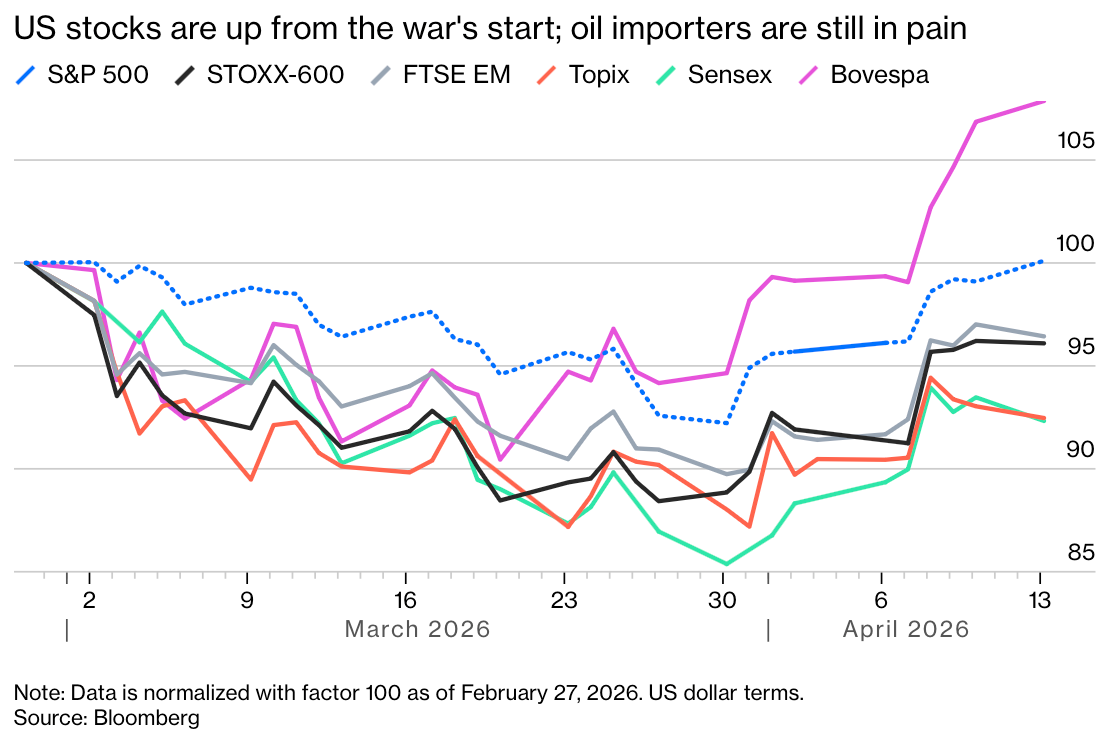
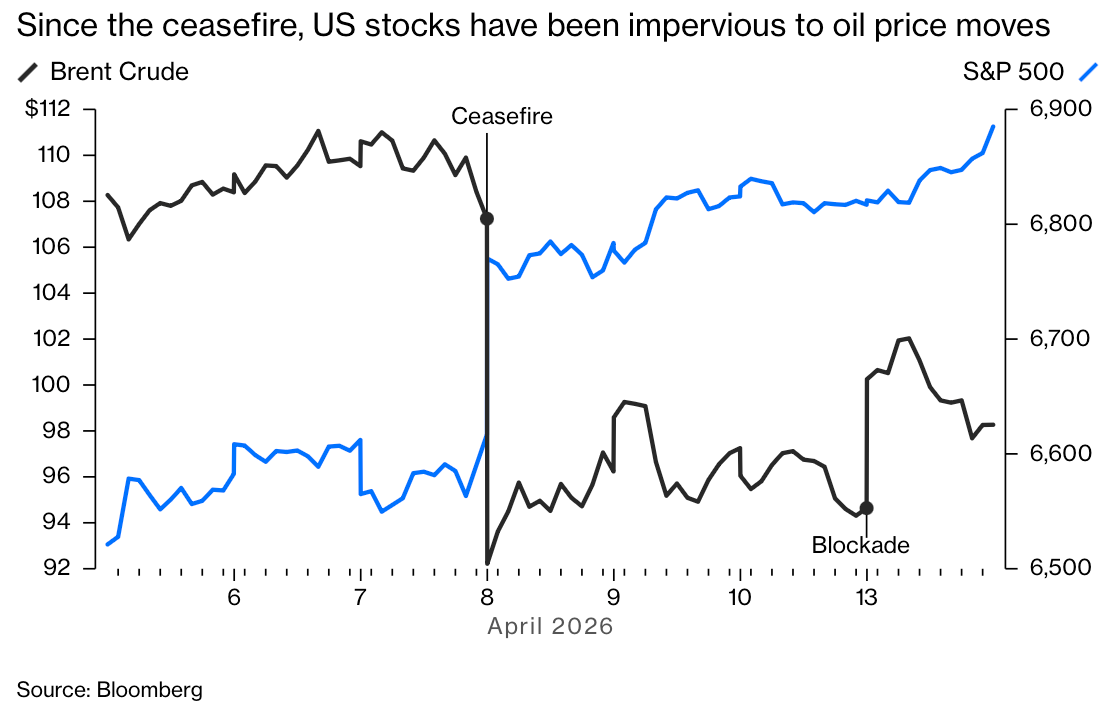
As the chart above shows, the US markets have turned positive on the year even with the increase in oil prices following the failure of negotiations. In fact, markets turned up as soon as rumours of peace talks began circulating at the end of March, even as Trump was threatening to wipeout the Iranian civilization. Oil prices seem to have decoupled from the stock market (below).
The market volatility index (VIX) has returned to pre-war levels (below) suggesting that markets are beginning to assume that some resolution, or at a minimum no significant escalation, to the War. Even at its peak, the VIX was well below the levels seen in early April 2025 following Trumps initial tariff announcement. There are several plausible reasons that the markets are viewing the current situation as manageable:
- Market is looking beyond the current headlines: The failure of a single round of talks is only one data point in a sequence of events, and markets respond to changes in the expected distribution of outcomes, not to headlines in isolation. Arguably, expectations were low that the talks in Pakistan would yield much progress and thus their failure had little effect on the markets. Benjamin Graham (a famous value investor) once said of the markets, “In the short run, the market is a voting machine, but in the long run, it is a weighing machine”. We are seeing this play out. Markets are reacting to short term events while the long term risks remain in place, unchanged.
- Macro data remains resilient: Despite the recent rise in oil prices and accompanying rise in inflation, macro data remains roughly in line with prior expectations. Reuters’ survey of economists late in 2025 found consensus expectations for slightly faster US growth and sticky but manageable inflation in 2026, with no immediate recession in the baseline. While the Iran war has clearly added upside risks to inflation via energy prices, current data are more consistent with a moderate‑growth, moderate‑inflation environment than with a sudden downturn, which historically allows markets to look through temporary geopolitical shocks.
- Earnings remain unaffected in the short run: Recent earnings results for the first quarter along with guidance have been largely consistent with prior guidance. These results are not raising concerns yet for traders. Even with higher real yields and compressed multiples, equities look attractive relative to bonds and cash if investors assume earnings growth to absorb part of the shock. Reuters points out that the S&P 500 forward P/E falling below 20× has made valuations more palatable, especially for secular growth sectors like technology. Meanwhile, long‑duration bonds have sold off on higher‑for‑longer rate expectations, reducing their appeal as a defensive alternative.
- Sector rotation from “war trades”: The market seems to view the current conflict as “containable”. This is shifting capital from “war trades” such as defense contractors to more growth oriented names. In fact, AI- and semi-related names have been rising considerably over the last few sessions.
- History suggests a temporary shock: Historically, local conflicts have tended to effect markets only in the short run. This historical playbook—that sharp geopolitical selloffs are followed by strong 12‑month returns from the trough if economic damage is contained—gives long‑horizon investors a rationale for buying into weakness and staying invested through noisy diplomatic developments such as failed talks. The current market appears to be seen as a “buy the dip” moment.
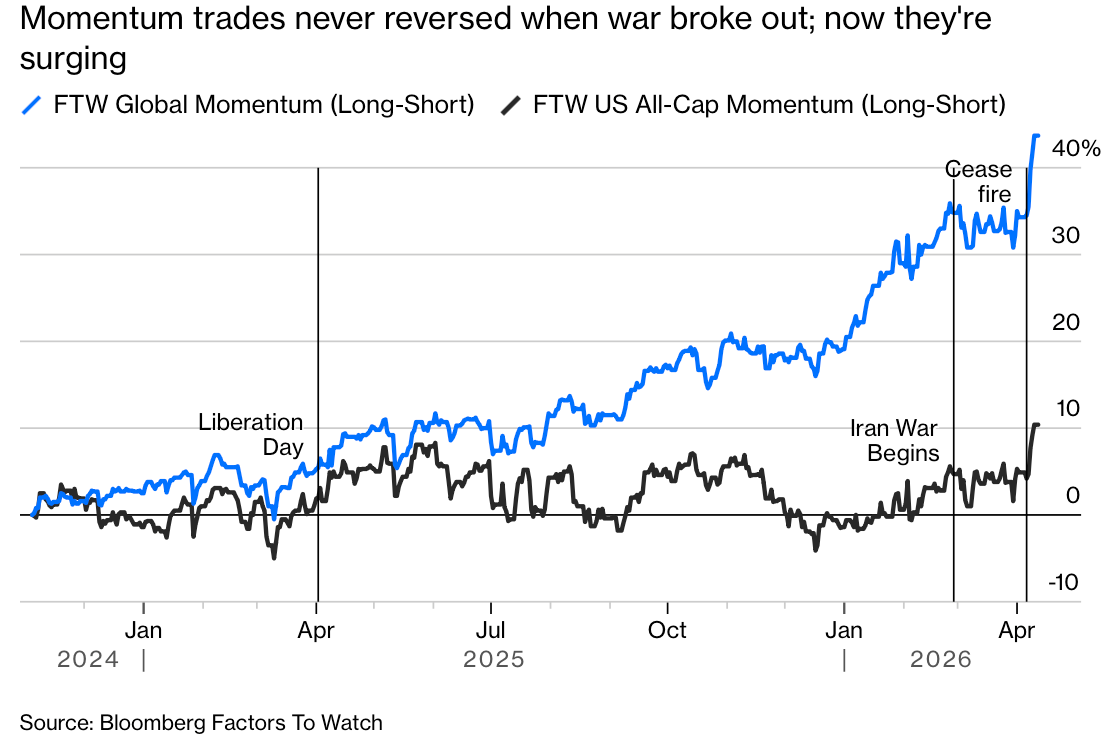
In all, markets appear to be willing to look beyond the current conflict. Momentum trades, as measured by the Bloomberg “Factors-to-Watch” Global Momentum Index have continued their upward march which has been in place since before Trump took office (below). Momentum has outperformed globally as well as in the US (it is in fact higher globally). It seems that the War has not been enough of a shock for investors to abandon their “buy the dip” strategies.
The markets are not pricing much if any tail risk right now. They seem to be assuming that unless the conflict continues for many months that all effects will be manageable. From our perspective, there are several factors’ investors should watch out for:
- Escalation:Iran has threatened to attack Gulf States oil production facilities if the US blocks the Strait for a prolonged period. If Iran follows through and does long term damage to Middle East oil production, then global growth rates and inflation expectations may need to be adjusted to reflect a long term change in supply. This likely would have negative consequences for bonds and equities.
- Inflation and Interest Rates: If the conflict begins to raise inflation expectations significantly, then the Fed may need to pivot towards raising rates. Presumably this would have negative consequences for investors.
- Earnings Disappointments: The markets are assuming that the consequences of this conflict are containable. However, if higher prices begin to creep into consumer expectations for an extended then we could see the markets pivot to reflect slower growth. The US economy is heavily reliant on consumer consumption (70%).
- Financial Stability: The US Government has already asked Congress to approve $200B in additional funds for the war effort. They have also asked for an additional $1.5T for military spending without any clear plan on where the funds are going to come from. At some point, the deficit may rise to a level that is unpalatable for Bond investors. There already is considerable concern over US Federal debt levels.
INVESTOR TAKEAWAY:
Tail risk is one of the most difficult aspects for investors to deal with. Being to optimistic or pessimistic tends to lead to subpar returns at best and higher levels of volatility than most are comfortable with. Each investor should assess whether their portfolio reflects the current risks and whether they are comfortable with it. As the market pivots towards a more risk on stance, it is tempting to follow suit. This may be appropriate given the lack of clear indications that the War will increase dramatically in scope. The Trump administration seems to be more concerned with trying to find an offramp from the conflict without losing face. For those investors looking at the current market as a buying opportunity we would remind them to remain vigilant for signs of change. Conservative investors, or those focused on capital preservation, may want to wait for greater clarity before overweighting equities.