
Prediction Markets have been growing in popularity and in prominence. As they grow it is worth thinking about how they can be used by investors to assist in their information gathering. For those unaware, Prediction Markets are a recent form of exchange platforms whereby users can trade on the outcome of future events — from elections and economic indicators to sports and cultural moments — by buying and selling “event contracts” that pay out based on what actually happens. It is important to recognize that these “contracts” are intended to be binary. Either the event happens or it does not. The sheer range of what can be speculated on is interesting – particularly the sudden rise in non-sporting events such as elections, wars and the economy. They gained added prominence when speculators started betting on the War in Iran, particularly some suspiciously well timed bets on the timing of attacks. Below, we look at some of the issues surrounding Prediction Markets and how investors can use them for information gathering.
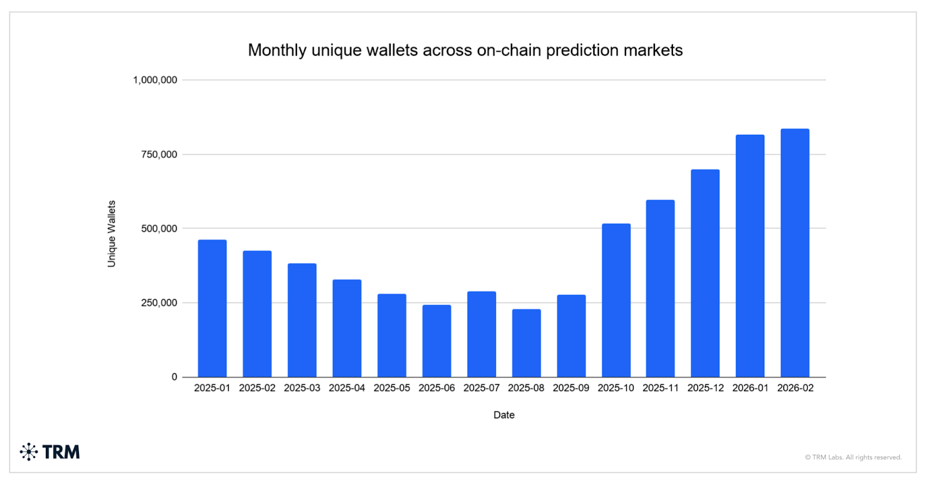
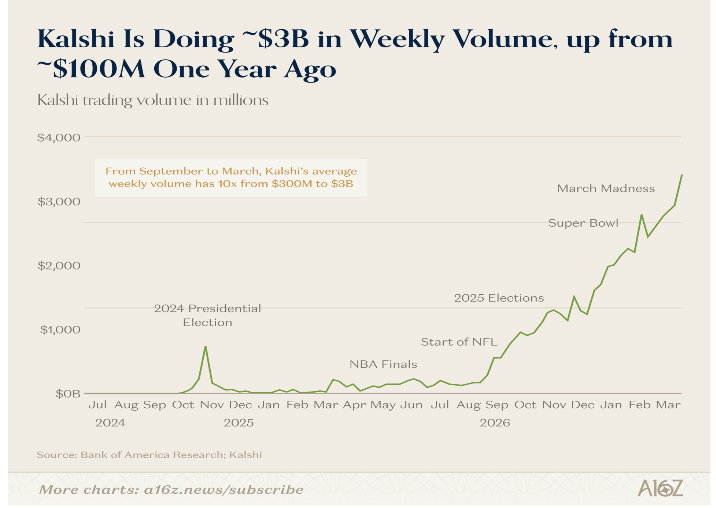
On the face of it, Prediction Markets seem like they would be niche products. However, they are undergoing astonishing growth. Bernstein Analyst, Gautam Chhugani estimates that total market volumes in 2026 will reach $240B this year (+370% YoY) with trading volumes reaching over $1T by 2030. The market is deemed attractive enough that many public company players are looking to enter the market such as Coinbase and Robinhood. At present, there are two major platforms, Kalshi and Polymarket. They have grown from niche players to significant markets over the last year (below, above). User growth has also followed (below, bottom).
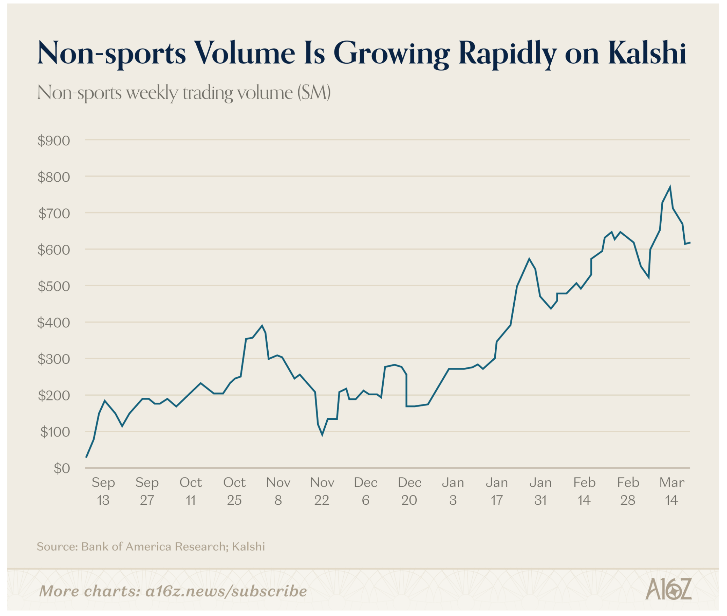
Originally, Prediction Markets were used as an alternative to sports betting. However, in recent months non-sports betting has been rapidly gaining momentum (below, right). This side of the business is attracting the attention of Wall Street. Many investors are viewing these markets as valuable sources of information because, unlike market analysts, users of Prediction Markets are wagering/investing actual dollars. In theory, they can be used for profit or to hedge exposures. From a certain perspective they are better than owning stocks or bonds to speculate on short term, high conviction ideas because of their binary nature. For instance, if I felt high conviction that Microsoft was going to beat earnings, I could offer an event contract that would pay out if they did, provided that someone was willing to take the other side of the contract. A successful payout would provide a 100% return (less any exchange fees) which is likely far more than one could get from the stock market which might only move a few percent up or down on the news. Of course, the flipside is that you would suffer a 100% loss if Microsoft did not beat their earnings numbers.
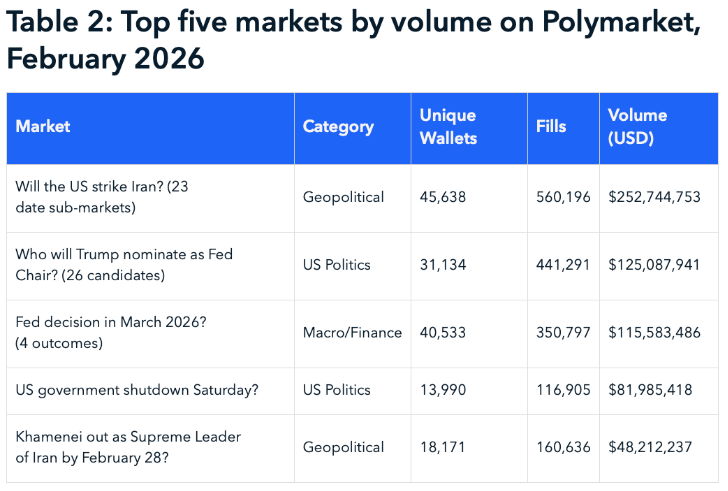
One of the other attractions to these markets is that they allow for users to profit from events that have no obvious benchmark but that may be market moving, nonetheless. For instance, election results can only be played in very derivative ways. Investors are forced to assess the odds of a particular result and what the effects might be on stocks and/or bonds. The issue is, you may get the first part right (who wins) but misjudge the secondary effects (market reaction). Prediction markets allow for a clear relationship between outcome and profit. In fact, we are now seeing substantial action in geo-political and macro finance contracts as evidenced by the Top 5 markets on Polymarket in February (below).
One question that arises frequently is whether Prediction Markets are really gambling/betting platforms. The Companies involved have gone to great pains to suggest that they are different. They offer “event contracts” not bets. The argument for these contracts being bets is simple – they are binary outcomes on events such as sports. The reason is simple, betting is highly regulated and involves fees, taxes and oversight. Derivative trades, or event contracts, are not regulated nearly as tightly. US State Governments have been arguing that this is gambling and needs to be under the auspice of State gambling laws. The current Federal Government has said no but it should be noted that both Kalshi and Polymarket employ Donald Trump Jr as a strategic advisor despite his having no experience in anything that they do. They have been pushing for any oversight to be from the CFTC (Commodity and Futures Trading Commission) which has much looser rules.
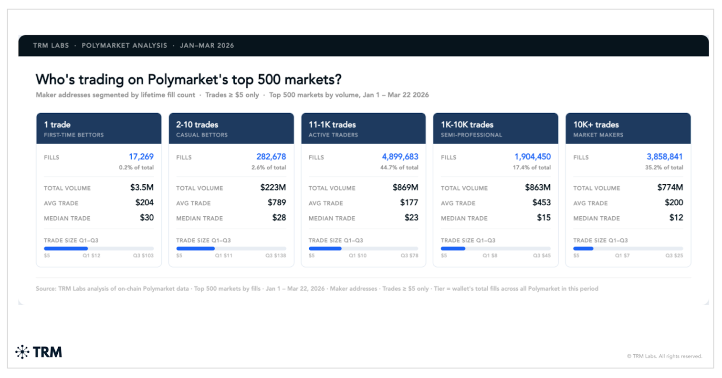
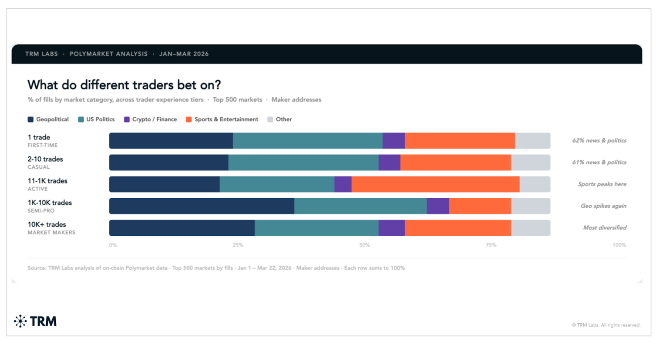
Increasingly, we see that users are not idly speculating on single events. Rather, they are using these platforms for high volume activity. For example, the majority of users on Polymarket are high volume traders (below) although it must be noted that the average volume per trade is still quite low. One of the reasons that trade size might be low is that it is still difficult finding counterparties for large contracts. We also see that the most active traders tend to focus more on non-sporting events (next page) which suggests that they are not trading for entertainment purposes.
One of the key concerns in these markets is the notion of “insider trading”. That is, trading on information before it becomes publicly available. In regulated markets, this is strictly against the rules and penalties can be harsh. Prediction markets, however, are not regulated and thus it is often speculated that insider trading is a feature not a bug in these markets. For instance, TRM (a crypt-compliance consultancy) observed:
“One example of analyzing patterns and timing to look for potentially suspicious activity comes from bets made surrounding the US airstrikes against Iran on February 28, 2026. In this example, TRM identified four wallets that collectively turned roughly USD 40k into USD 872k betting on US military action against Iran in January and February 2026. All four entered markets priced between USD 0.10 and USD 0.80 per share — implying 10–80% probability — and redeemed at USD 1.00 when the market resolved. These four wallets had largely never traded before and then came in at similar times to place a bet when the US would strike Iran.
TRM also observed shared infrastructure between these wallets. All four wallets funded their positions through the same bridge within a narrow time window. After collecting their winnings, all four swept their balances and have not re-entered the market. The synchronized wallet creation, shared funding source, identical exit behaviour, and concentration in a single geopolitical thesis raise questions about potential coordination or shared information.”
While this analysis is suggestive of something akin to insider trading, it is not conclusive nor does it seem to be illegal at present.
INVESTOR TAKEAWAY:
As prediction markets grow, their potential utility to investors also grows. While we wouldn’t suggest that anyone participate in these markets directly, especially without a clear understanding of the risks, they do serve as a potential source of insight. As the odds on these markets moves, one can get an insight into what people are thinking. By paying special attention to large or unusual patterns, one can see potential red flags with respect to major events. This is especially true as long as these markets remain un- or lightly- regulated. This will become particularly interesting as the frequency and size of the investments continue to increase as institutional investors begin to look at using these markets for hedging and profit.