
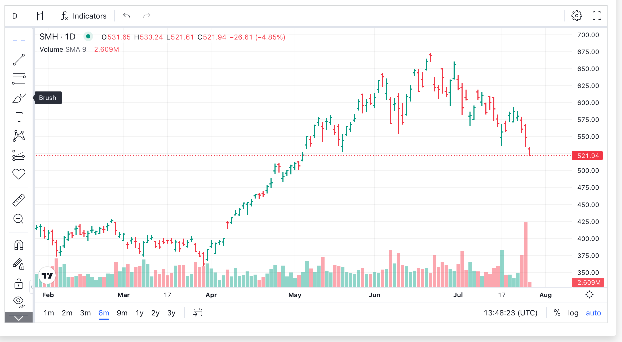
Markets have experienced recent volatility of late, led by the AI-centric chips stocks which have been selling off dramatically as investor concerns about the AI buildout mount. The Semiconductors sector nearly doubled from April to late June and has since dropped 20% (below). The major hyperscalers, AI providers, and chip companies have continued their pattern of self-dealings and investors are beginning to take note.
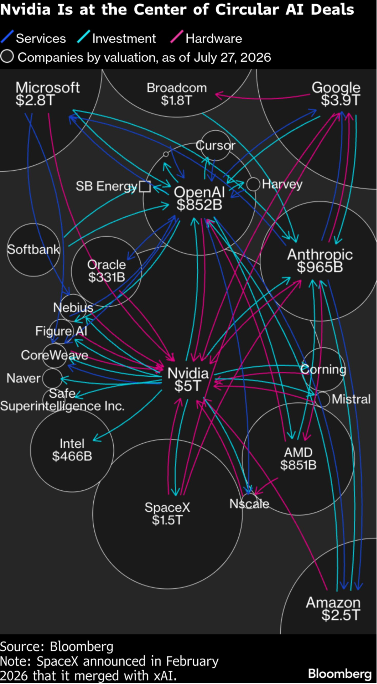
The recent selloff was juiced by reports that Nvidia was going to guarantee $250B in loans for OpenAI to allow OpenAI to build a 10 GW data center in Ohio. This center would consume the power equivalent to about 8M homes and the expected cost is approximately $500B. This follows a recent partnership announcement between Nvidia and SK Hynix (a large South Korean memory chip maker) involving $500B of interconnected financing to build out AI data centers on the Korean Peninsula. Google also recently agreed to backstop lease payments for Anthropic across 5 data centers amounting to $35B. Furthermore, investors have begun to more closely scrutinize the many Neocloud deals (Neoclouds are smaller scale computing providers such as CoreWeave and Nebius Group) involving loans backstopped by allocations from Nvidia and other chip providers. The loans are in turn used to buy more chips. In all, the web of interconnected deals keeps getting larger and more tangled (below).
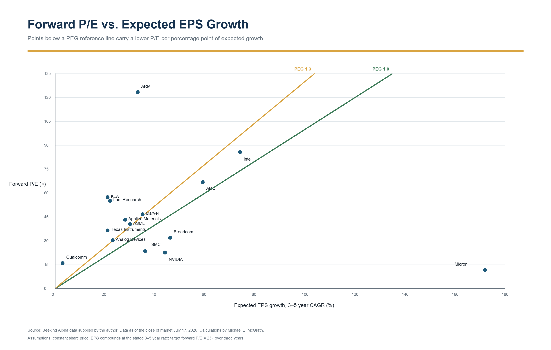
It is important when looking at the sector, however, to be careful not to overreact to headlines or fear. As with all investments, one needs to weigh the risk and reward. Some companies are trading at extremely optimistic valuations while others have room for error. Surprisingly, many of the large players are trading at more reasonable levels compared to their peers. For instance, as the chart below highlights, some of the largest chip companies such as Nvidia, TSMC, Broadcom and Micron all trade at forward earnings P/E’s well below their growth rates (PEG or P/E to Growth). Whereas some, such as ARM are trading at elevated PE’s and will need a lot to go right to justify their valuations.
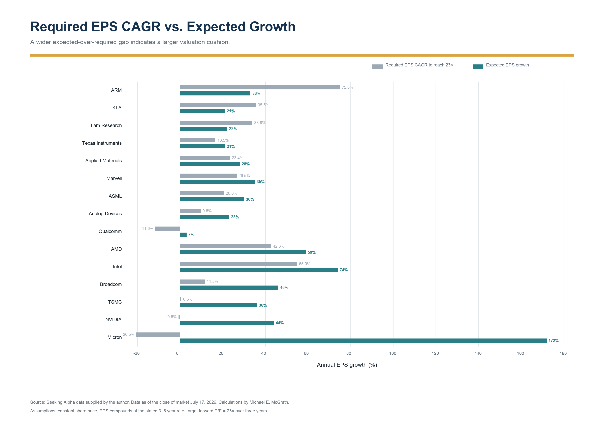
Extending this analysis to look at the required EPS growth rates vs expected growth based on analyst forecasts again shows that some companies have strong cushions in the case of a downturn (below). Micron, in particular trades at an extremely low multiple relative to its expected growth rate (~175%). This is largely because investors remain wary of memory chip companies’ tendencies towards cycles of boom during shortages (present situation) and busts during capacity buildout.
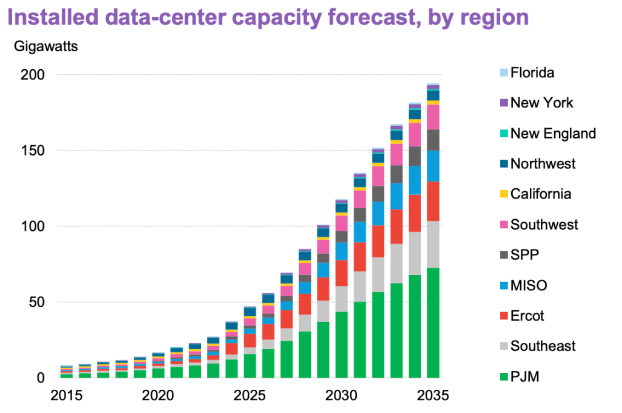
While quantitative analysis can be very helpful, one should always look deeper. As mentioned previously, much growth in the sector is predicated on the rate of AI buildout. If there is a significant adjustment to the rate of construction, then analysts will be forced to bring down earnings estimates. Circular financing is only one potential roadblock to future data center construction. National forecasts project data center power capacity requirements to surge between 90 GW and 125 GW by 2030, scaling up to 194 GW by 2035. This would amount to an incremental 25% of total US power consumption (below).
Investor Takeaway:
We are expecting continued volatility within the AI sector as investors attempt to make sense of the proposed AI buildout and how it will be financed. The challenge is that this sector is likely to be very important to the global economy going forward. Conservative investors may want to avoid or significantly reduce exposures where possible. It is important to properly determine one’s exposure because most ETFs have significant holdings. Those investors wishing to maintain exposures would probably be wise to look at some of the lower risk options to avoid any significant drawdown. At present, the market is very exposed to the financial viability of Anthropic and OpenAI and their ability to continue to raise significant financing will drive sector growth.