
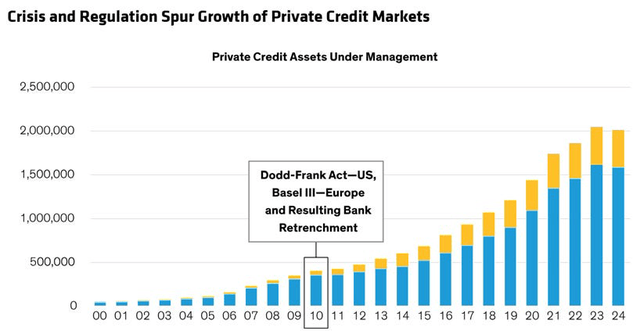
It seems that in those rare instances that market commentators are not discussing the state of the War in Iran, they are fretting about the potential consequences of a meltdown in Private Credit. Private Credit is often used interchangeably with direct lending. It refers to loans made directly to borrowers, usually Private Equity backed companies to fund their purchase, rather than loans made by banks or syndicated across many lenders. The market has grown from a niche market to over $2T in recent years. Any systematic disruption could have wider repercussions on the markets beyond direct exposures.
THE PRIVATE CREDIT LANDSCAPE
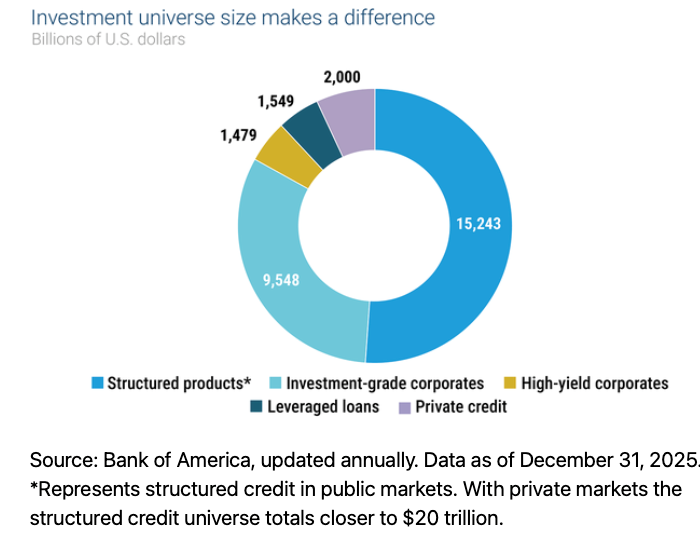
Following the Financial Crisis in 2007-08, regulators tightened the ability of banks to make risky loans. This opened the door for alternate lenders to fill in the gaps. From an almost non-existent asset class, Private Credit has grown to over $2T (below). While this is a big number, it still represents a minority of lending activity (below). The worry is that, as a result of its rapid rise to prominence, defaults may lead to disastrous knock-on effects. Recent defaults amongst some high profile borrowers as well as concern about the significant portion of lending to software companies that may be exposed to disruption from AI has led to concerns in the market.
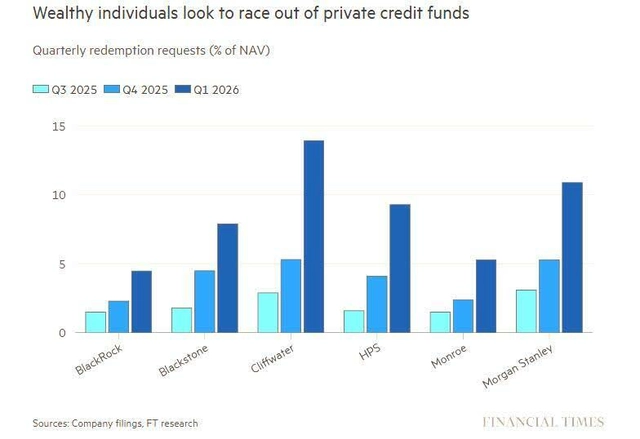
The heightened concerns have led to increased scrutiny of these assets. The sudden influx of capital into the asset class resulted in lots of dollars chasing a limited pool of deal and led to reduced lending spreads, looser underwriting standards as well as taking on less experienced/appropriate investors. This last point occurred as a result of the government loosening restrictions and allowing individual investors to enter an asset class that used to be limited to institutional investors such as pension funds and insurance companies. These investors generally have long investment horizons compared to individuals which can have varying capital needs and evolving risk tolerances. The recent concerns have led to an avalanche of redemption requests, akin to a run on a bank. Most funds are limited to 5% of assets to be redeemed in any given quarter.
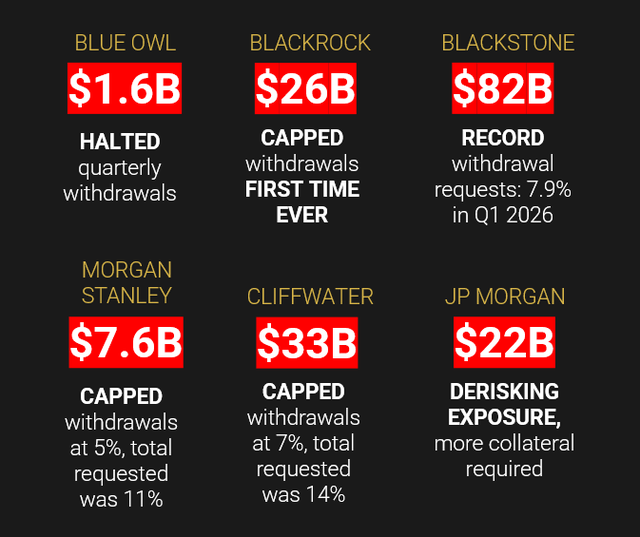
This approach made sense because the underlying investments tend not to be liquid as they are usually loans of 3-5 years in duration. Because they are made directly to the borrower and not as part of a syndicate there is no market for the Funds to sell their loans and raise cash without taking a severe discount to the holding value and disadvantaging those investors remaining in the Fund. Historically, gating has never been a major issue as returns have tended to be steady, default rates low and the investor base had long time horizons (below). Now, investors requesting their money back are facing “gating” whereby they are limited in how much, if any, of their funds they can get back. Perhaps surprisingly, the Funds affected have been some of the biggest players in the industry and have led to gates being deployed (below). This leads investors to tend to ask for full redemptions in order to get in the cue which can lock up the asset class.
Because the underlying loans are to private companies several issues have come to the fore. One, many of the asset managers that run these Private Credit Funds also run the Private Equity Funds (PE) that they are lending to. In essence, they are often lending to themselves. This creates an ethical dilemma as asset managers make far more money from successful PE investments than they do from lending. Two, unlike their public market counterparts, these firms are not required to mark-to-market the value of their portfolios. Hence, many of these portfolios are held at cost until there is a credit event such as a default. Third, many funds have taken a page from commercial real estate lenders and are employing an “extend & pretend” strategy. That is, they are changing the terms on potentially impaired debt to push out adverse events.
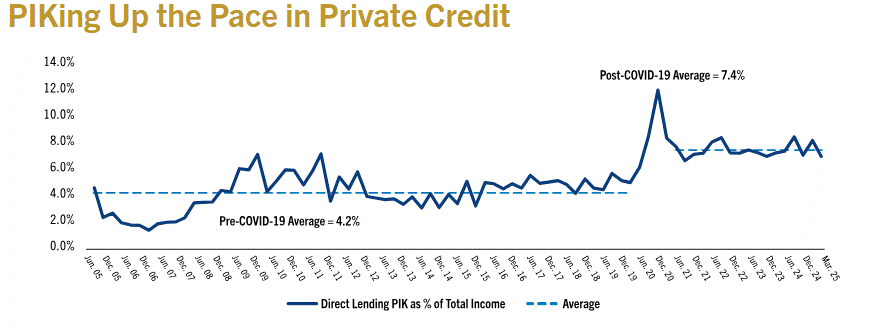
One such method is using Paid-in-Kind (PIK) structures (below). In a PIK structure, the lender just adds the interest from a non-accrual loan to the back end of the loan. This allows the debtor to keep current, even as they are not making their regular loan payment. The lender can benefit via a higher non-cash interest rate, provided the debtor eventually makes good. If a borrower is struggling to pay interest currently, it seems a bit farfetched that, with some exceptions, they will be able to pay a bullet payment of accrued interest and principal at the end of the loan’s life. All that has happened is that the Private Credit Funds have deferred the write-down and continued to collect fees on the full amount of the loan.
There are 3 major issues that Private Credit investors need to watch for:
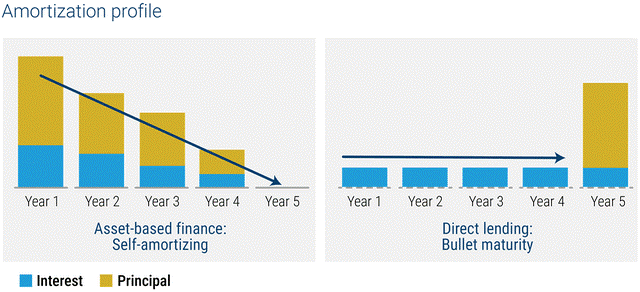
- Repayment Structure: Funds have used two primary approaches to lending. Asset based lenders tend to favour amortizing loans where blended interest and principal payments are made over the course of the loan (most mortgages and car loans are structured this way; below). Other lenders, favour bullet-maturity loans whereby interest only is paid until the loan comes due at maturity (below). Obviously, this latter approach exposes lenders to refinancing risks at maturity.
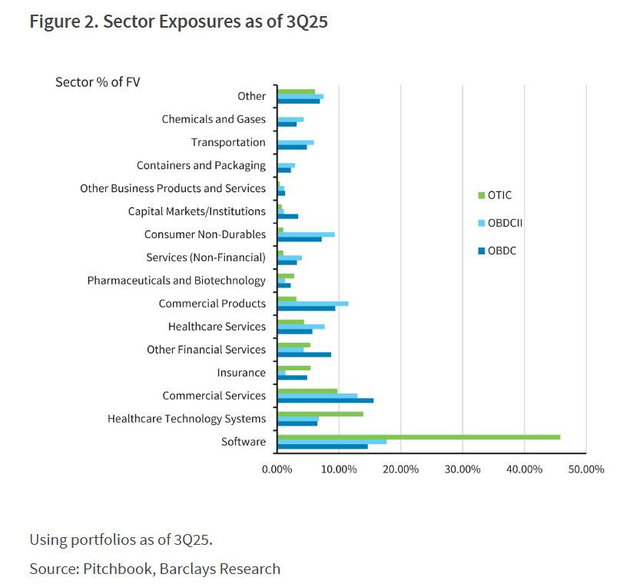
- Collateral: Traditionally, PE firms tended to focus their buyout activity on asset intensive, cash flow rich businesses. Private Credit loans to these industries tend to be secured by hard assets, inventory and even real estate making them inherently less risky. More recently however, they have put more funds towards asset light technology investments (below is an example for Owl Rock one of the major Private Credit players). The latter investments are “secured” by SaaS (Software-as-a-Service) contracts which are typically renewed annually. The shift in investment focus was largely driven by the desire to drive quick exits as technology tends to have a greater M&A appetite, public market exits are easier and exit multiples are higher. Recently, however, AI has increased the risks that these software companies will be obsolete before they can payback their loans. In the case of default, the lenders have little actual value as the IP tends to be worth very little.
- Liquidity: Most Funds tend to have a manager-controlled gate and other restrictions that govern investors redeeming the fund early. Typically, these funds have 10-15 year timelines. Investors need to be prepared for the fact that in times of stress, these funds will control exits in their favour.
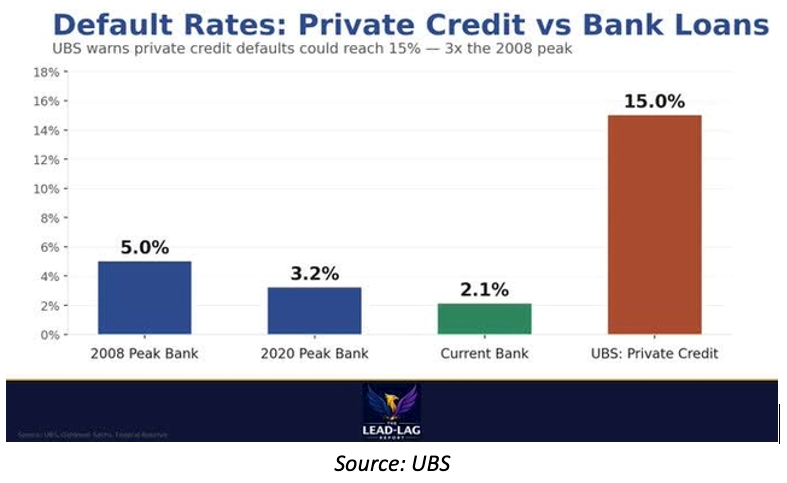
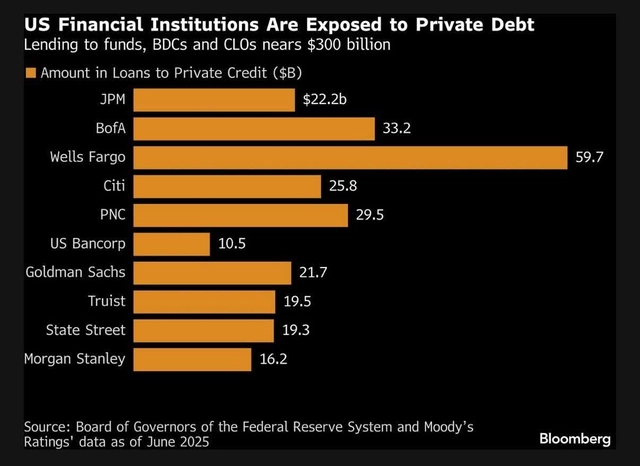
The looser regulation surrounding these funds means that their balance sheets are more risky than traditional lenders. Recently, UBS estimated that Private Credit defaults could peak at 15%, far exceeding levels from prior credit crises (below). It is important to remember that any issues with respect to Private Credit could spill out into the major banks as they have lent heavily to the sector (below).
INVESTOR TAKEAWAY:
Every investor should pay some attention to what is going on in the Private Credit markets. The primary concern for investors who do not have direct exposure to the Private Credit is the knock-on effects if there is a major issue. Credit spreads are likely to increase, and corporate lending standards will become tighter. This can affect bond portfolios significantly. Also of note is that banks and insurance companies have exposures to these Funds through lending and direct investments. It is estimated that Life Insurance companies can have up to 30% of their assets tied up in these funds.
It is important to remember that this is not an actual crisis right now and may not ever be one. Many market analysts predict that this fear will blow over without any major issues beyond normal levels of credit default. Many funds are very well run and manage their risks appropriately. The challenge of investors in the space is to try and see into this opaque world and assess whether their investments are commensurate with their risk tolerance. These investments were intended to be long run in nature and so they may well weather near term volatility.