
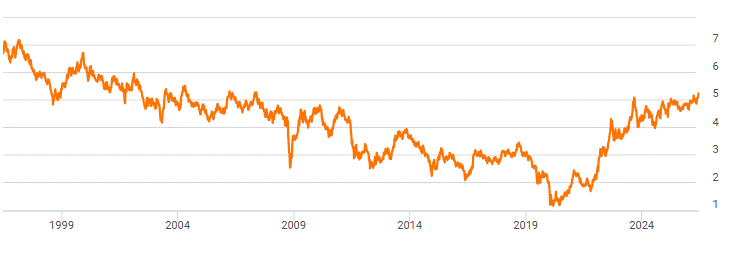
Equity markets hit new highs last week as investors seem to be embracing risk again. AI stocks, in particular, caught interest as many stocks had strong weeks. At the same time, treasury yields on the 10-yr bond increased about 100 bps. The 30-yr treasury eclipsed the 5.2% barrier for the first time since 2007 (below). Ordinarily, equity markets fall when rates rise which raises the question of which market is right?
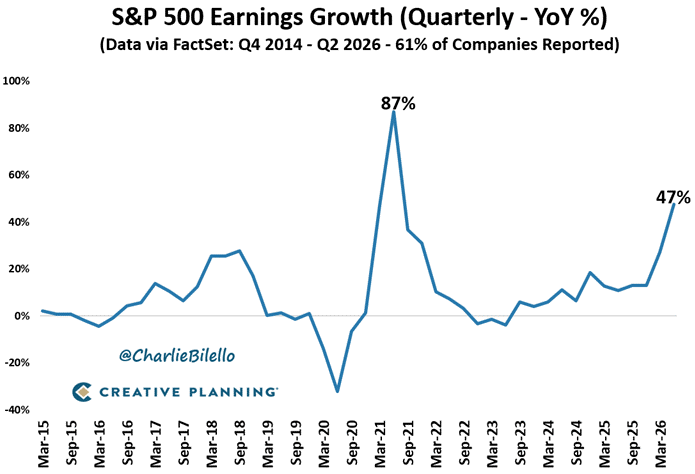
Equity markets have been buoyed by strong earnings growth (below). With most of the major S&P 500 companies reporting, earnings growth overall has met or exceeded consensus estimates. The major narrative has been that the US economy is very strong despite all the negative macro headlines (inflation, war, etc.).
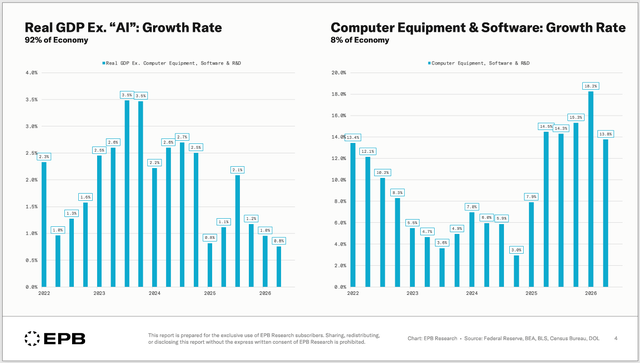
The economy seems to be largely driven by AI capex spending. It is currently expected to be more than 2% of US GDP this year, totaling over $700B. What is troubling to many is that the recent GDP growth results of Q4 ’25 of 0.5%, Q1 ’26 of 1.6% and Q2 ’26 of 1.5% suggest that the economy would be in rough shape without the aggressive AI build underway (below).
The other major worry is that the bulk of the revenues and backlog supporting this growth are from OpenAI and Anthropic, neither of which are profitable. For instance, it is estimated that 70% of Microsoft’s AI revenues come from OpenAI. If either of these companies hit a speed bump, then the entire AI ecosystem may suffer. Further, current AI revenues are thought to be around $150B while capex is soon to be topping $1T annually. It is difficult to see how these investments will be able to drive a reasonable return. As an example, Sequoia Capital partner David Cahn updated his analysis of returns on AI infrastructure investment, estimating that the AI industry would need to generate $3 trillion in earnings to cover projected spending and related costs by 2026. According to PANews, citing TechCrunch, Cahn calculated global AI infrastructure investment at about $1.5 trillion in 2026, and said that after adding data center operating costs and operator profits, the required industry earnings rise to $3 trillion, which he noted may be an underestimate. Currently, the entire software market is estimated at $900-950B. AI will have to be truly transformational in short order to justify the current levels of spending. Bulls have been unconcerned by these arguments as they see near limitless potential for AI to help companies generate revenues and reduce costs, thereby increasing earnings significantly.
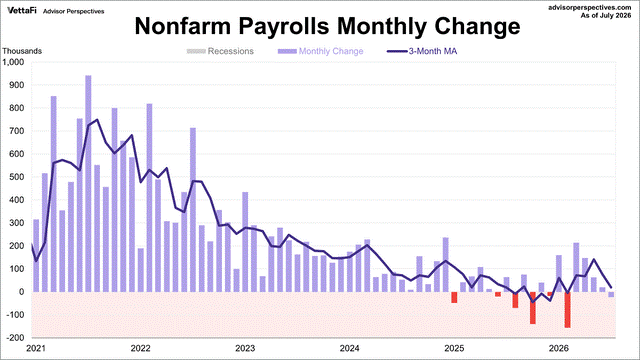
The Bond Market doesn’t seem so convinced. Job growth for July was negative and there were major downward revisions for May and June. This has continued a trend of weakening job growth in the US (below).
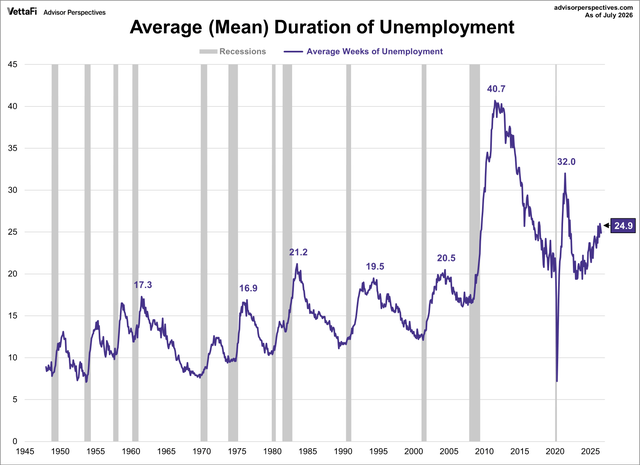
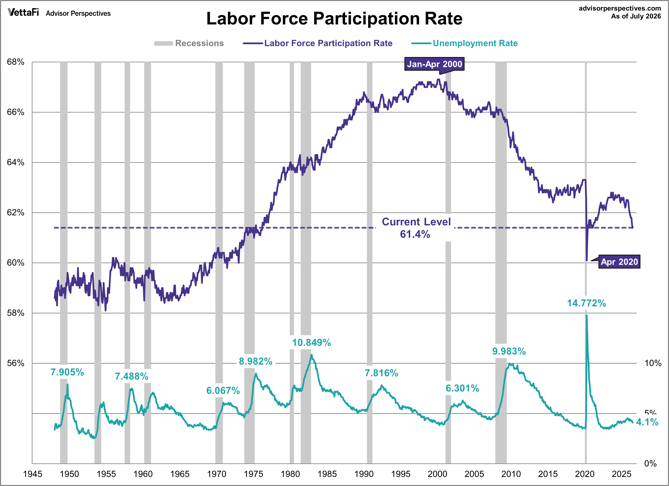
The average duration of unemployment suggests that workers are finding a much harder time finding new jobs (below, first). The mean duration of unemployment stands at 25 weeks and rising. These are levels only since twice before (since 1950), following the Great Financial Crisis and briefly during the aftermath of Covid. Furthermore, the labour participation rate has dropped to levels not seen since the 1970’s when women hadn’t fully entered the workforce (below, second). Some of these trends can be attributed to an ageing populating and people leaving the workforce early.
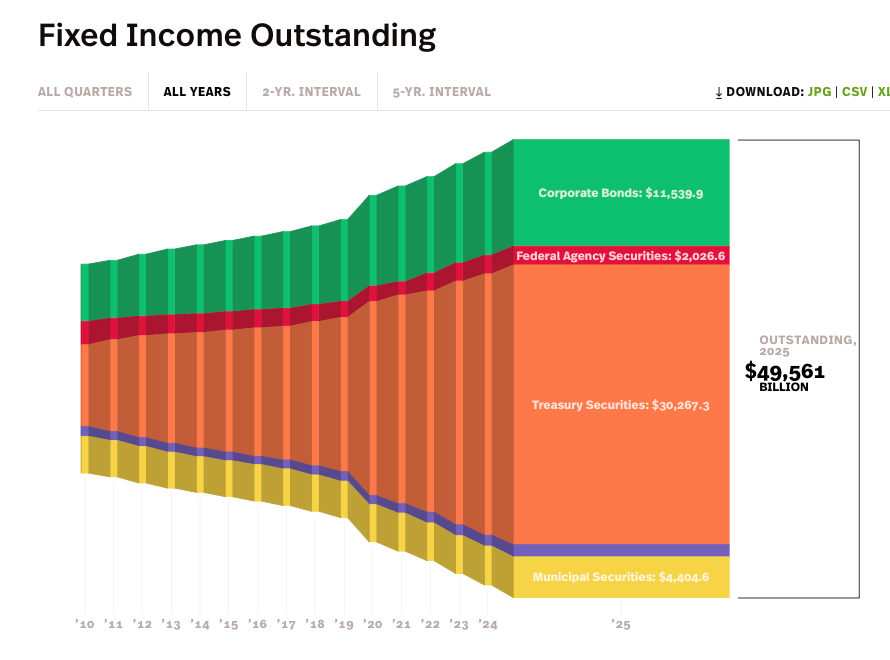
The other big concern for the bond market is the rising levels of debt in both the government and corporate markets. The US makes up about 40% of the global bond market so changes within this market can have effects far beyond its borders. The total US fixed income market is about $50T, with $11T being corporate debt (below). The recent actions by the US Treasury to step in and help support the Yen was seen as less of an instance of the US helping an ally and more a case of the US trying to protect its long term bond market. Japan holds over $1T of US debt and the thinking was that they may be forced to sell holdings to finance support for the Yen. By assisting in currency support the US was also supporting their long term yields from rising too high. This is a major issue for them as they are expected to run a fiscal deficit of around $2T this year and interest servicing costs are now the number 2 highest government spend item.
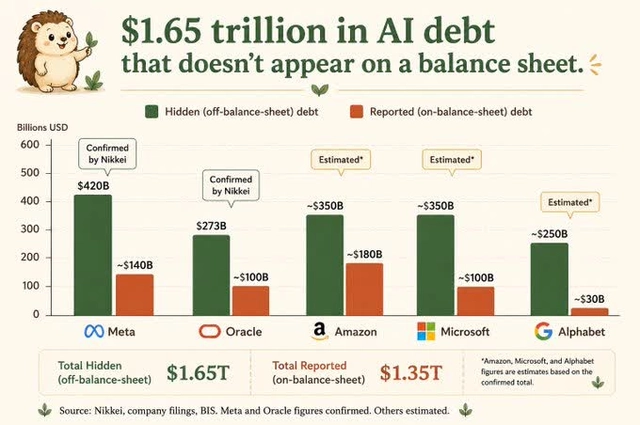
A recent analysis by Nikkei Asia suggests that global hyperscalers have incurred an additional $1.65T in debt that doesn’t appear on their balance sheets (below). If this behaviour continues, bond markets may begin to seriously question the viability of the AI strategy. Most of these companies have already moved to being free cash flow negative and the “additional” debt could prove burdensome. This is especially concerning given that many of these companies (i.e. Meta, Oracle, Google, SpaceX) have begun to sell excess capacity because their own current usage cannot justify the expenses.
Investor Takeaway:
The market seems to be in a precarious position that may take months to sort out. Earnings growth seems to justify the current premium valuation multiples (~40X using the cyclically adjusted PE ratio). However, consumers do not seem to be benefitting from any of the AI spend in a meaningful way. Not only is unemployment troubling but consumer savings are moving towards all-time lows. This suggests that it won’t take much to trigger a selloff in the markets. Investors should be monitoring their high multiple positions carefully, to ensure that they don’t get caught in a downdraft. The bond market worries should not be discounted.