
As we write this missive, the market is awaiting the results of Trump’s latest ultimatum with respect to the War with Iran. He took a very dour tone over the weekend, proclaiming: “Tuesday will be Power Plant Day, and Bridge Day, all wrapped up in one, in Iran. Open the F***in’ Strait, you crazy bastards, or you’ll be living in Hell – JUST WATCH!” He followed up with, “A whole civilization will die tonight, never to be brought back again. I don’t want that to happen, but it probably will. However, now that we have Complete and Total Regime Change, where different, smarter, and less radicalized minds prevail, maybe something revolutionarily wonderful can happen, WHO KNOWS? We will find out tonight, one of the most important moments in the long and complex history of the World. 47 years of extortion, corruption, and death, will finally end. God Bless the Great People of Iran!” The difficulty for the markets is assessing what is likely to come next – TACO (Trump Always Chickens Out), catastrophic bombardment of Iran or something in between. Given the fact that he seems to be painting himself into a corner, it is likely that some form of escalation will ensue. How Iran responds is anyone’s guess. In the meantime, investors are urged to be cautious heading into this binary event as we will reserve comment until there is more clarity.
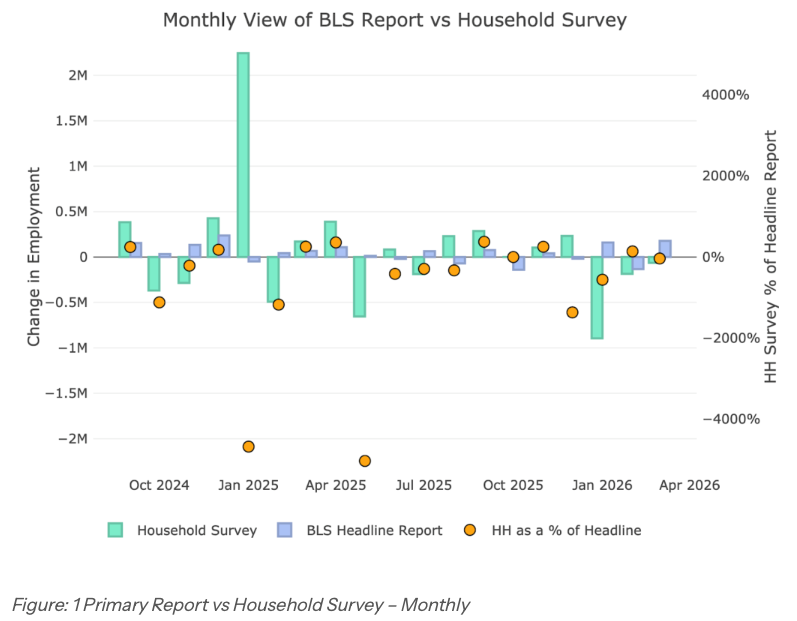
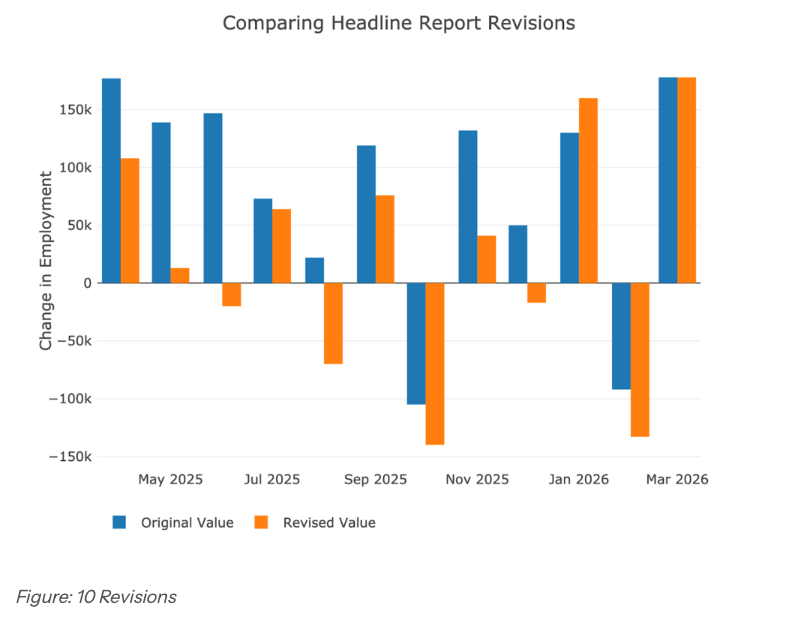
Setting aside Iran for the moment, it is wise for investors not to lose sight of other factors that may come into play and affect portfolio performance in the near and longer term. One such factor that we feel should not be overlooked is employment trends in the US. Recent employment data released by the Bureau of Labor Statistics (“BLS”) showed a headline uptick in employment for March of 178k jobs (below, left), handily beating expectations. While the markets reacted positively to the news, upon deeper inspection there are reasons to be less enthusiastic. For one, the data is notoriously noisy. Also, the data has a history of significant revisions (below, right). Concerningly, there is quite a disparity between the BLS Headline Report and the Household Survey (“HH”).
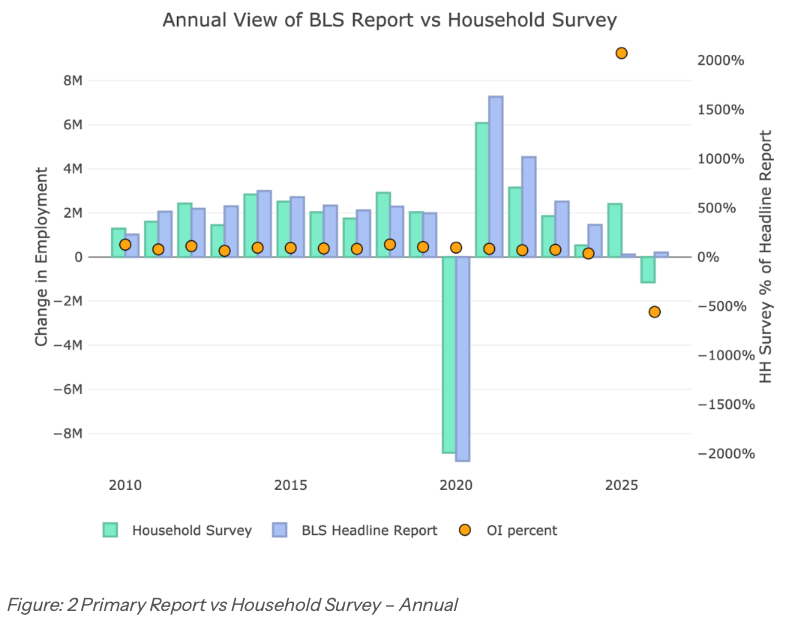
This disparity grows even more significantly when one looks at the annual data (below). The Headline Report showed a gain of 205k jobs for the year, which while well below historical levels was a gain, nonetheless. The Household Survey paints a completely different picture, showing a loss of 1.4M jobs in 2025. There are several key differences between these two surveys. The BLS survey looks at jobs in total by looking at payroll additions through a survey of employers (a person with two jobs is counted twice). The Household Survey counts people with jobs and includes the self-employed and farm workers. Thus, the recent positive divergence between the BLS and HH surveys may indicate a big increase in people holding multiple jobs.
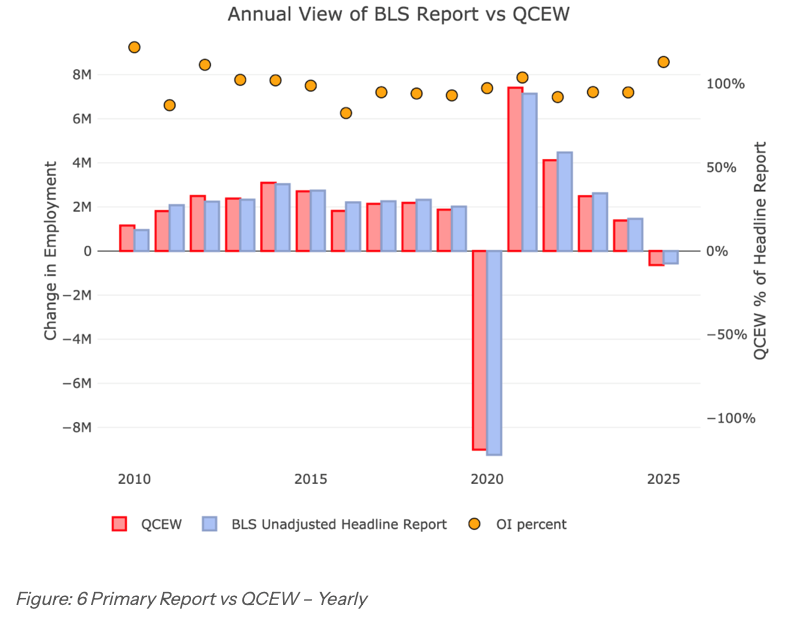
This negative view is reinforced when looking at the Quarterly Census of Employment and Wages (QCEW) data which is considered to be more accurate. The annual view of this data shows that employment gains have been dropping since the COVID rebound and are now trending below historical levels (below).
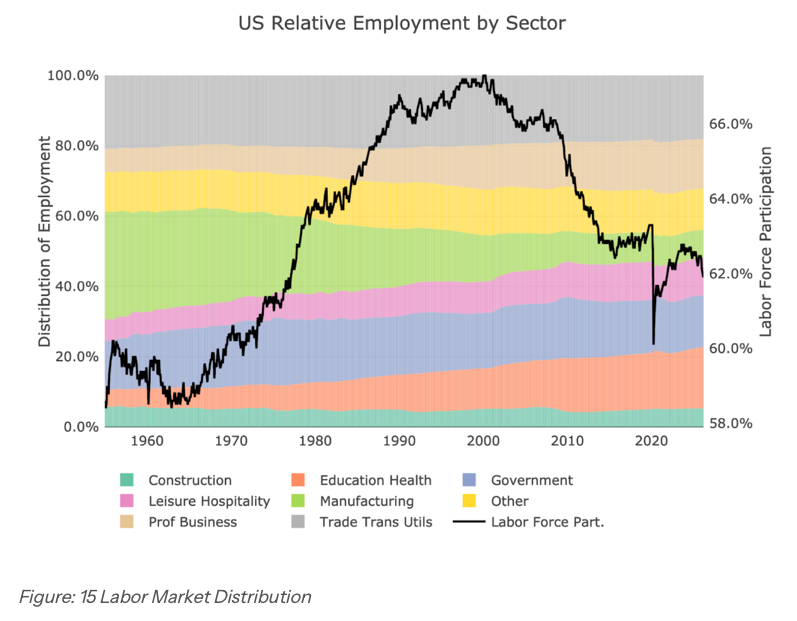
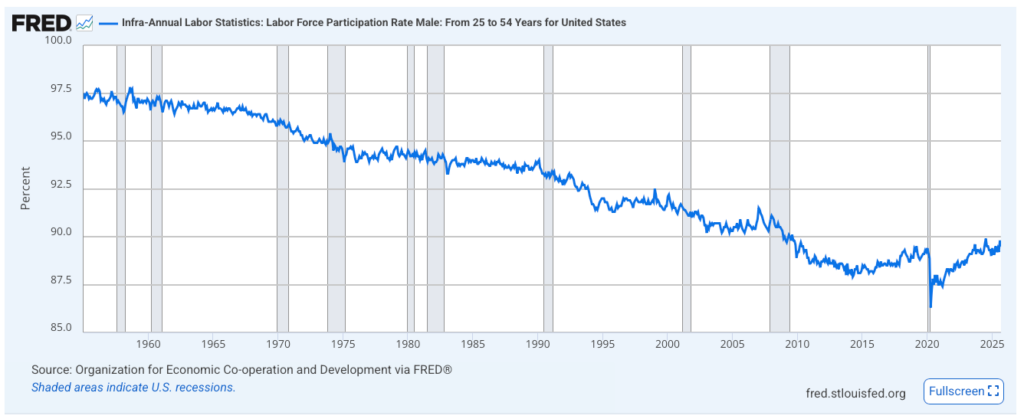
Compounding this is the marked drop in participation since the turn of the century (below, top). The percentage of adults in the labor force has dropped from a peak in the late 1990’s and early 2000’s of 67% to under 62% currently. Some of this is due to the ageing population which is now beginning to retire. However, much can also be attributed to a decline in working aged males (25 to 54 yrs old) who have seen their participation rates drop from 98% to less than 90% (below, bottom). The combination of an ageing population and a large segment of working aged people falling out of the workforce foretells many challenges in the coming years. It is estimated that over 1 in 5 people in the US will be over 65 years of age by 2030. Further, the elderly will be outnumbering children soon. Recent policies to limit immigration are likely to lead to a declining population. This will put a great deal of stress on the US economy as fewer workers will be available to support an ever-growing number of seniors.
INVESTOR TAKEAWAY:
For long-term investors, it would be wise to pay attention to the changing demographics in the US and globally. It is easy to get caught up in the short-term news cycles and forget about potentially important structural changes. They will offer both opportunities and risks to investors. In the near term, it is important to recognize that the data is noisy and politically speaking, governments have tended to favor releasing more optimistic results and revise them down later. Given the massive upheaval in the US government this is probably amplified. Astute investors can use market turbulence as a buying opportunity for long dated bets on shifts such as an ageing population. For instance, healthcare, assisted living and population shifts to warmer climates are relatively obvious beneficiaries. Overall purchasing behaviours are likely to shift as the population gets older. Less obvious but potentially more rewarding may be the shift to AI and automation as tools to increase productivity in the absence of employment growth. They also pose further risks to employment if they gain traction at a faster rate than people drop out of the workforce.