
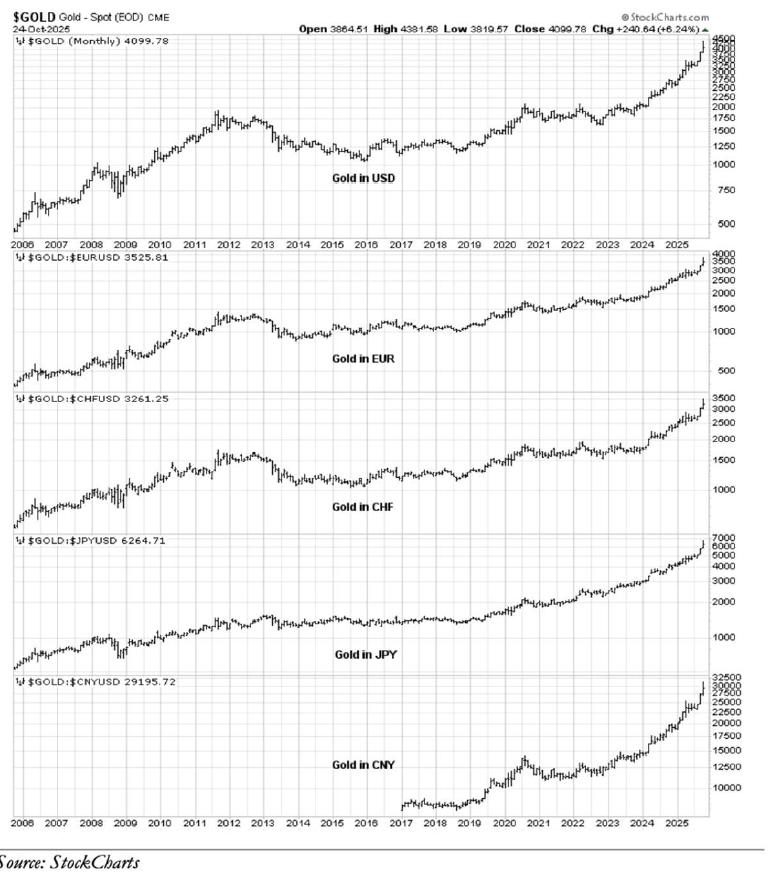
For the last year, we have been constructive on gold investments. For the most part, over that span any investment in gold, whether it be physical gold or gold miners, has paid off handsomely. Gold has been on an impressive run against all major currencies over the last couple of years.
Recently however, gold appears to have peaked at around $4,300 per oz. It has since trailed off to about $4,000 per oz. due to a variety of factors. This raises the question of whether this marks a rotation out of gold and into other stores of wealth or whether this is a period of consolidation in a longer bull market run. Below, we look at some of the arguments surrounding this question.
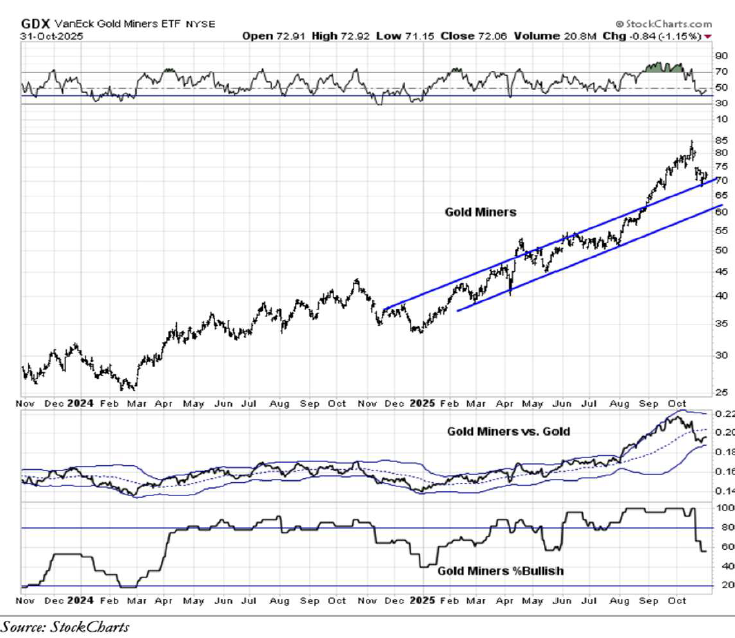
One of the arguments for selling gold appears to be the sharp increase in gold miner prices recently. They broke out of a price channel to the upside in August and appeared due for a correction. In many respects this correction may be dealt with in the short run, particularly when viewed as the price of gold miners (GDX as a proxy) versus gold price.
The recent tentative “agreement” by the US and China over tariffs and trade also had an effect on gold trading. The announcement that agreements had been reached sent gold down below $4,000, at least temporarily. The reality is that there was little of substance that was actually agreed to. China has said it would begin purchasing soybeans at close to its previous levels (although nowhere near peak levels). China also agreed to assist in reducing the sale of fentanyl and fentanyl precursors into the US – a promise they have made many times before. Finally, they agreed to resume some level of rare earths exports – an agreement that seems hollow given that many experts believed that they didn’t have the facilities in place to block many exports anyway.
It is also important to remember that there is nothing that has been formally agreed to. Neither party has signed an agreement, and this is just a 12-month pause. Nevertheless, the agreement is viewed by many as a sign of calmer times and a signal to increase allocations to risk assets.
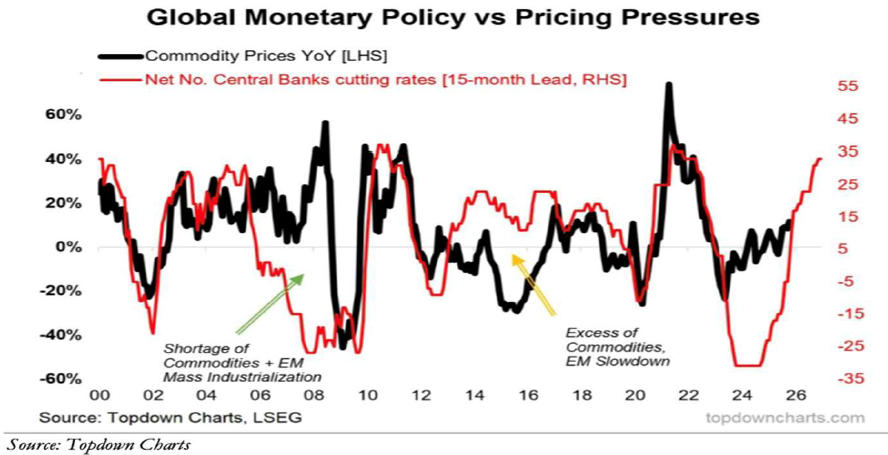
Countering this argument are the actions of the Fed. They have recently reduced rates by 25 bps. Further cuts are expected later this year or early next year. Regardless, it is likely that the next Fed Chair, who will be in place by mid-2026, will be chosen for his dovish stance and pliability to government desires. This will lead to increasing market expectations for future rate cuts and potentially higher inflation, as the current government is more concerned about easy monetary policy to deal with their debt servicing than they are with inflation.
This will likely lead to lower rates, a lower dollar, higher inflation and higher commodity prices. This relationship has held true in the past.
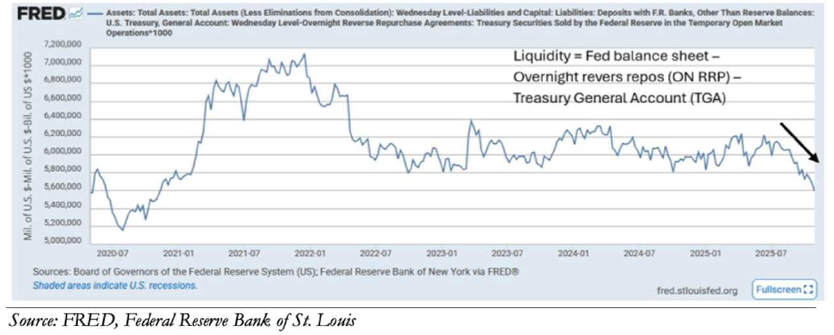
The Fed has also announced the end of its quantitative tightening program (QT) starting December 1. For the past three years, the Fed has been slowly shrinking its balance sheet following the massive surge during the pandemic. Most of the balance sheet runoff was from a deposit facility where money market funds could park cash – known as the overnight reverse repo facility. This facility is mostly drained now, and the Fed does not want to affect the cash held by banks, which they use for lending.
The end of QT signals the Fed’s balance sheet is likely to grow as fiscal deficits rise and the Fed may be called upon to assist in yield curve management. That is, the Fed is likely to have to step into the markets and buy Treasuries to prevent interest rates from rising too fast. These actions are likely to increase investor concerns over inflation and increase demand for gold.
Investor Takeaway
While gold may take some time to consolidate major gains over the year, it doesn’t seem like conditions are right for a significant pullback. We think many investors and central bankers, for that matter, view gold as a worthwhile hedge against the current high levels of chaos associated with the US government.
While it may be prudent to take some profits at this point, we do not think that investors should abandon their gold holdings and rotate into risk assets or bonds. The bond argument, based on the assumption of lower rates, may play out, but recent price action indicates that a steepening of the yield curve is likely in the short run, at least until more clarity over trade and the government shutdown emerges.
In the long run, there are many red flags that suggest the US may hit troubles. For one, there is an over-reliance on AI stocks to create wealth. Two, employment trends are negative and especially challenging for younger workers. Three, the US deficit continues to remain a concern. These factors lead us to believe that there may be more left in the tank for gold despite the current pause from all-time highs.